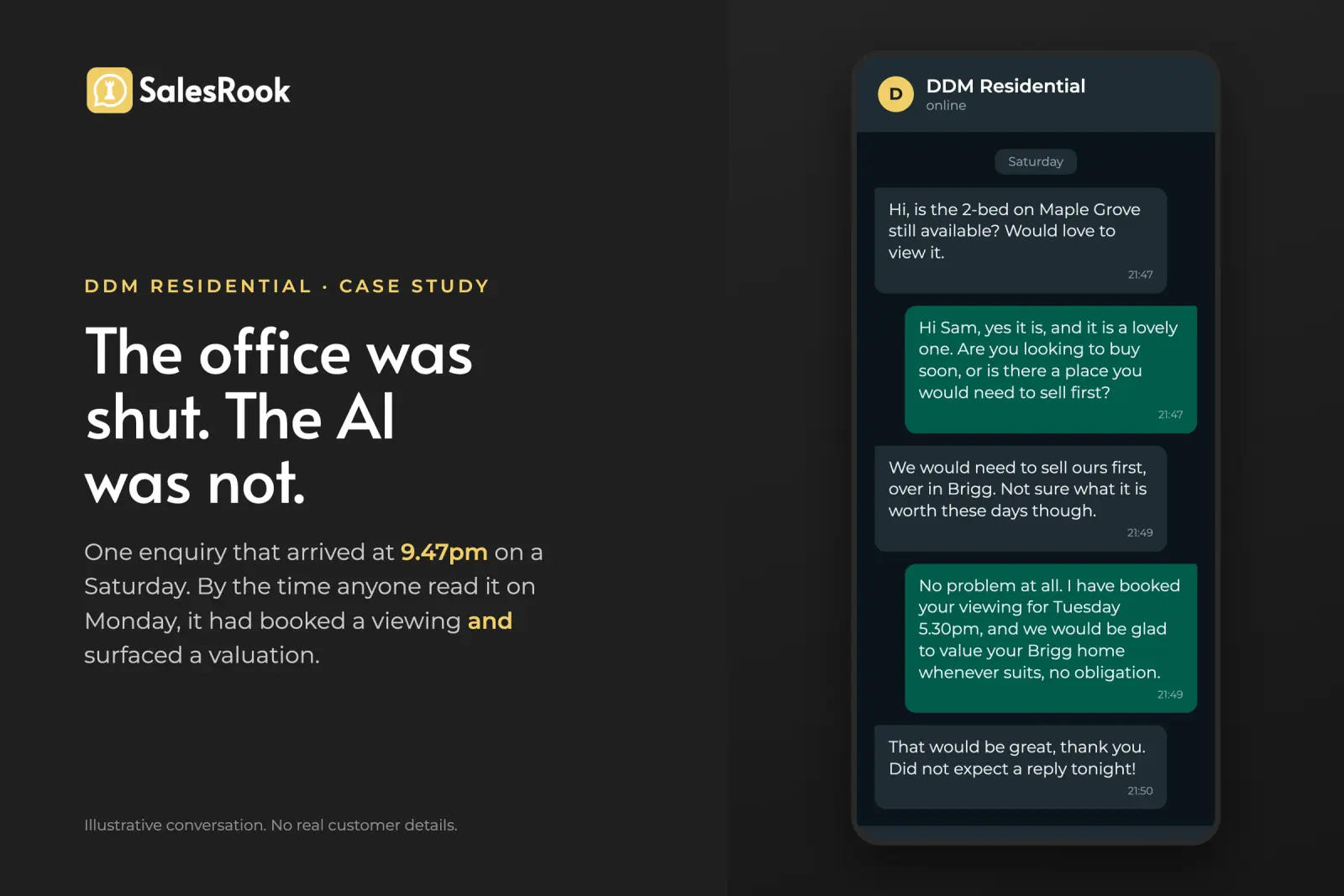
Picture a Saturday, a little before ten at night. The DDM Residential office in North Lincolnshire has been locked and dark for hours. A buyer, half-watching the television, taps out a message about a two-bed they have just seen listed. Is it still available, and could they take a look. On most weekends, at most agencies, a message like that sits unread until Monday. By Monday, the buyer has often moved on. At DDM, it does not wait. A reply goes back the same evening, not a canned "thanks, we will be in touch", but a real question in return, warm and specific, that keeps the conversation going.
The colleague who sent it is called Kelly. Kelly handles the enquiries DDM receive, on WhatsApp, on the website, and through missed-call text-back once the phones stop being answered. Kelly works Saturdays, Sundays, bank holidays and the small hours, and never once asks for the time back.
Kelly is not a person.
Kelly is the AI agent DDM Residential built with us, and this is what the better part of a year of Kelly answering the door looks like, told through DDM's own numbers rather than mine. That scene above is a representative one, not a single logged enquiry, but the pattern behind it is very real.
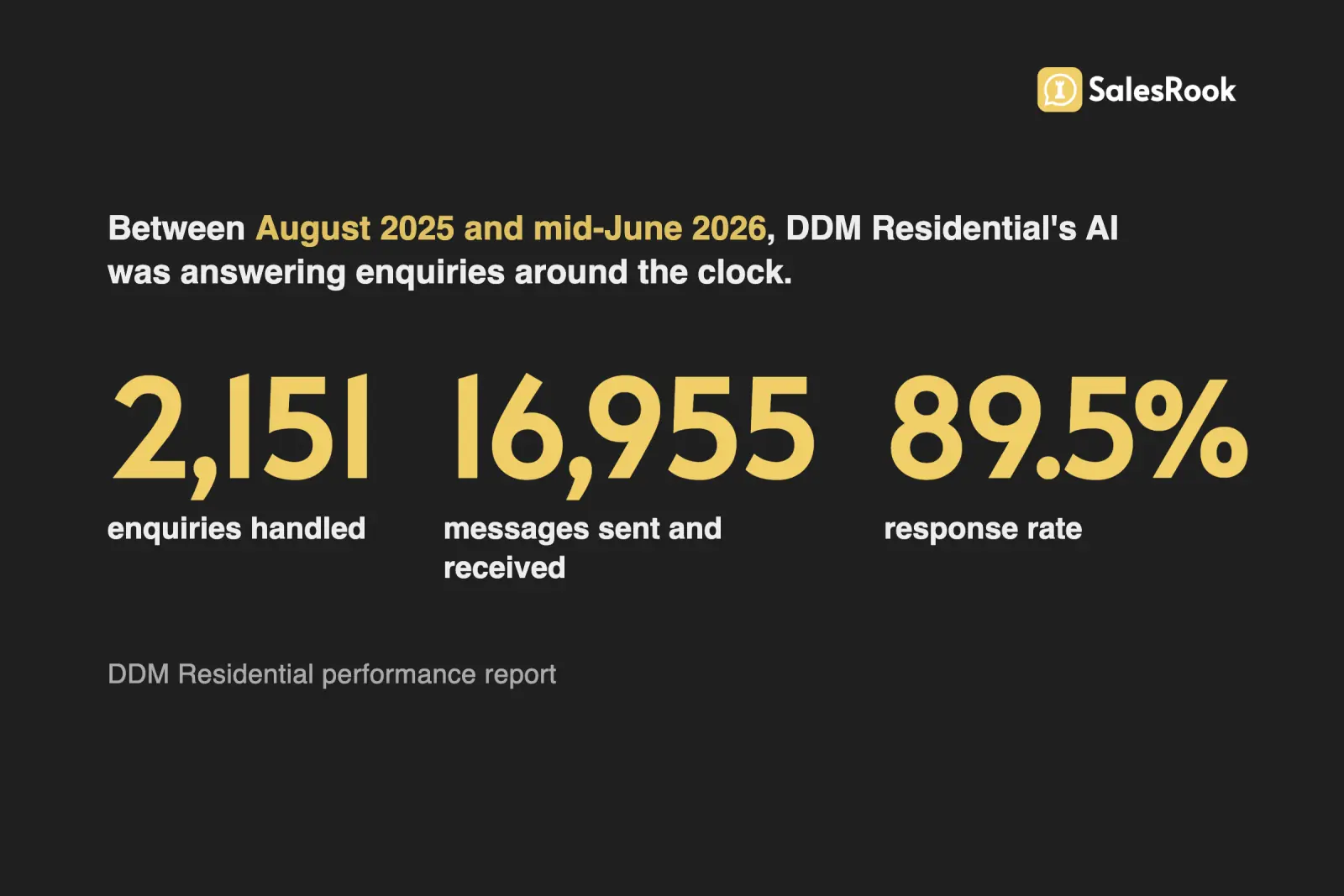
DDM Residential's own SalesRook performance report, 1 August 2025 to 15 June 2026. Same portals, same team. The AI simply answered the enquiries and read each one.
The enquiries that arrive when the office is dark
DDM Residential are an established independent agency covering the Scunthorpe and Barton-upon-Humber patch, with a lettings arm alongside the sales business and a place in the area-exclusive Relocation Agent Network. When we met them they were not short of enquiries. Almost no established agency is. They had a full complement of portal listings, a steady stream of buyers, and the same problem nearly everyone has: a good share of those buyers arrive at exactly the moment there is no one at the desk.
Property does not enquire nine to five. People browse Rightmove from the sofa in the evening and from bed at the weekend, precisely when the office is closed. And the enquiry that waits until Monday is very often the enquiry you risk losing, because speed weighs heavily now. In a July 2026 Street Group survey of 1,830 sellers, 85% said they expect a reply within 24 hours, and a good many expect it far sooner than that. The agency that answers while the buyer is still holding the phone is far better placed to win the viewing.
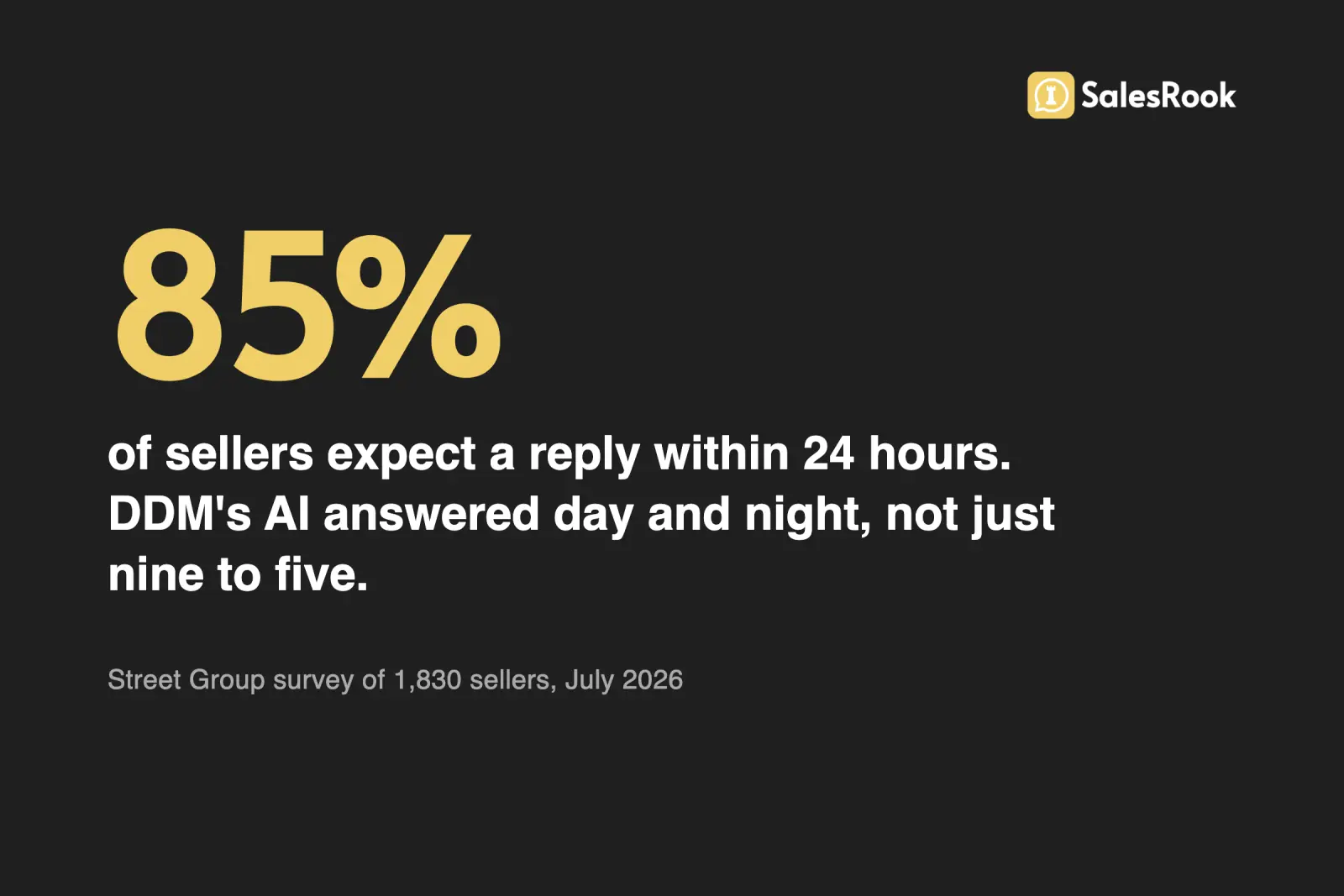
Sellers now expect a same-day answer, and buyers vote with their thumbs. An enquiry answered while the buyer is still holding the phone is far better placed to turn into a viewing.
And remember what that inbound stream already costs before anyone even replies to it. The average agency now pays Rightmove around £1,530 a month, and that figure keeps climbing: the portal's revenue rose 9% to £425.1m in 2025 as the average spend per agency climbed. When an enquiry has cost that much to generate, letting it go cold on a Saturday night is an expensive habit. DDM did not need more of them. They needed to stop losing the ones they already had.
You do not have to take my framing for it. Midway through the period this report covers, on an ordinary review call in January, DDM's managing director David Gardner put it in his own words:
"We've got this AI that if somebody sends through a Rightmove, bang, the customer journey, they're picked up straight away... They're interacting straight away. And even if that's eight o'clock at night, it's kicking in."
David Gardner, Managing Director, DDM Residential
2,151 enquiries, 16,955 messages
is what Kelly handled for DDM Residential between August 2025 and mid-June 2026, answering on WhatsApp, on the website and via missed-call text-back after hours. The office sleeps. The enquiries do not.
What all that answering was actually worth
It is worth remembering what this job feels like done by hand. In August 2025, right at the start of the period this report covers, the director who runs DDM's lettings business described the enquiry pile to us exactly as every agent will recognise it: "We just get email after email of people just saying, I'm interested, I'm interested. Following them up, they're not interested or we can't ever get a hold of them. That is so time consuming."
Here is the part that surprises even the sceptics. Once the enquiries were being answered promptly, day and night, and, just as importantly, read properly rather than met with a stock "yes, still available", they turned out to be worth far more than anyone had assumed. Over the period, DDM's report shows Kelly fully qualified 796 of those conversations and kept a response rate of 89.5% across the contacts its report counted.
That is the mechanical part. The commercial part is what those qualified conversations contained. Reading each message properly, rather than skimming it for a viewing and moving on, is how you find the seller hiding inside a buyer. Someone asking about a two-bed flat is very often someone who also has a house to sell, and they will mention it in passing if the conversation is warm enough to invite it. Across the period, that careful reading surfaced 192 valuation opportunities for DDM, of which 56 were pre-market sellers, people thinking about selling who were not yet on anyone's books. Those are potential instructions that would otherwise have walked straight out of a routine buyer enquiry.
None of that required a bigger marketing budget or a single new lead. It came from answering the enquiries DDM were already paying to receive, and reading them closely enough to catch what was inside. That is a management choice long before it is a piece of software, and it is the same lesson we saw at Michael Poole, another Relocation Agent Network member, whose enquiries hid far more instructions than anyone had realised until someone started reading every one.
The valuation hiding inside a buyer question
It is worth slowing down on how a valuation surfaces, because it almost never announces itself. A buyer does not open with "I would like to book a valuation". They open with a question about a property they like, and somewhere in the exchange they let slip that they will need to sell their own place first, or that they are moving out of the area. Miss that line and you have booked a viewing. Catch it and you have found a valuation opportunity.
The difference is entirely whether the enquiry was read, or merely answered.

The buyer who lets slip that they have a place to sell is usually at home, off the clock, half-expecting no answer until Monday. Reply warmly the same evening and the valuation inside their question is there to be asked for.
Do this once and it is a nice anecdote. Do it across enquiry after enquiry, evening after evening and weekend after weekend for the better part of a year, and it becomes 192 valuation opportunities that a busy team would otherwise never have had the hours to chase. The prize was never more leads. It was more attention paid to the ones already in front of them.
139 mortgage referrals the team never had to chase
There is a second thing careful reading surfaces, and for an agency with a financial-services arm it matters just as much. A buyer who mentions they still need to arrange their mortgage is a buyer who could be introduced, at exactly the right moment, to someone who can help. Left to a stretched sales team, that introduction is easily missed, because by the time anyone has the headspace the buyer may well have sorted it elsewhere.
Over the period, DDM's report logs 139 mortgage referrals surfaced from qualified sales enquiries, roughly one in six of them. Those are warm, timely handoffs into their own mortgage business, spotted in the flow of an ordinary property conversation and passed on while the interest was still live. Same enquiries, same team. The only difference is that the mortgage cue in the message was noticed instead of scrolled past.
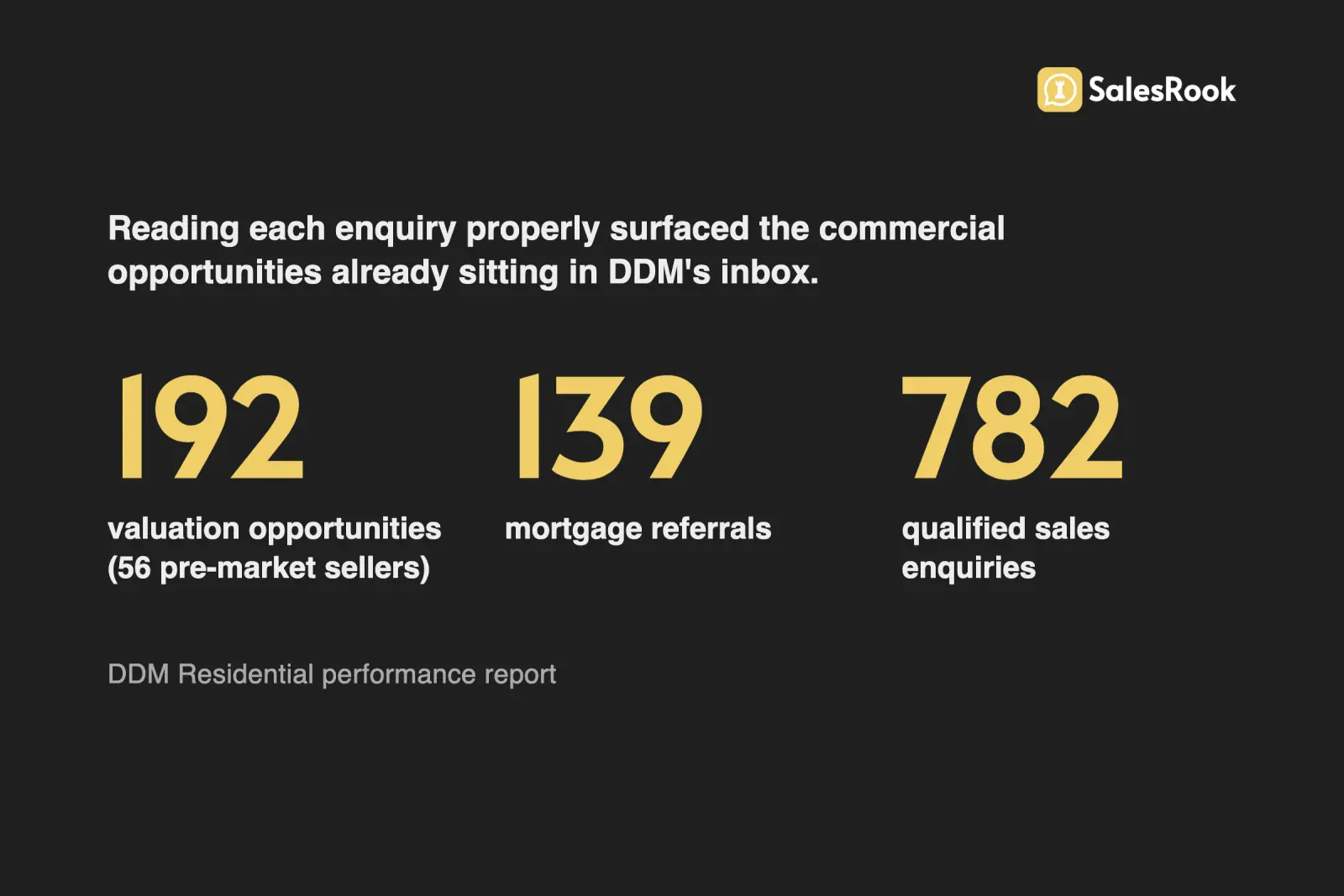
The opportunities were already in the inbox. Valuation opportunities and mortgage referrals surfaced from enquiries DDM were already paying to receive.
530 hours nobody had to work
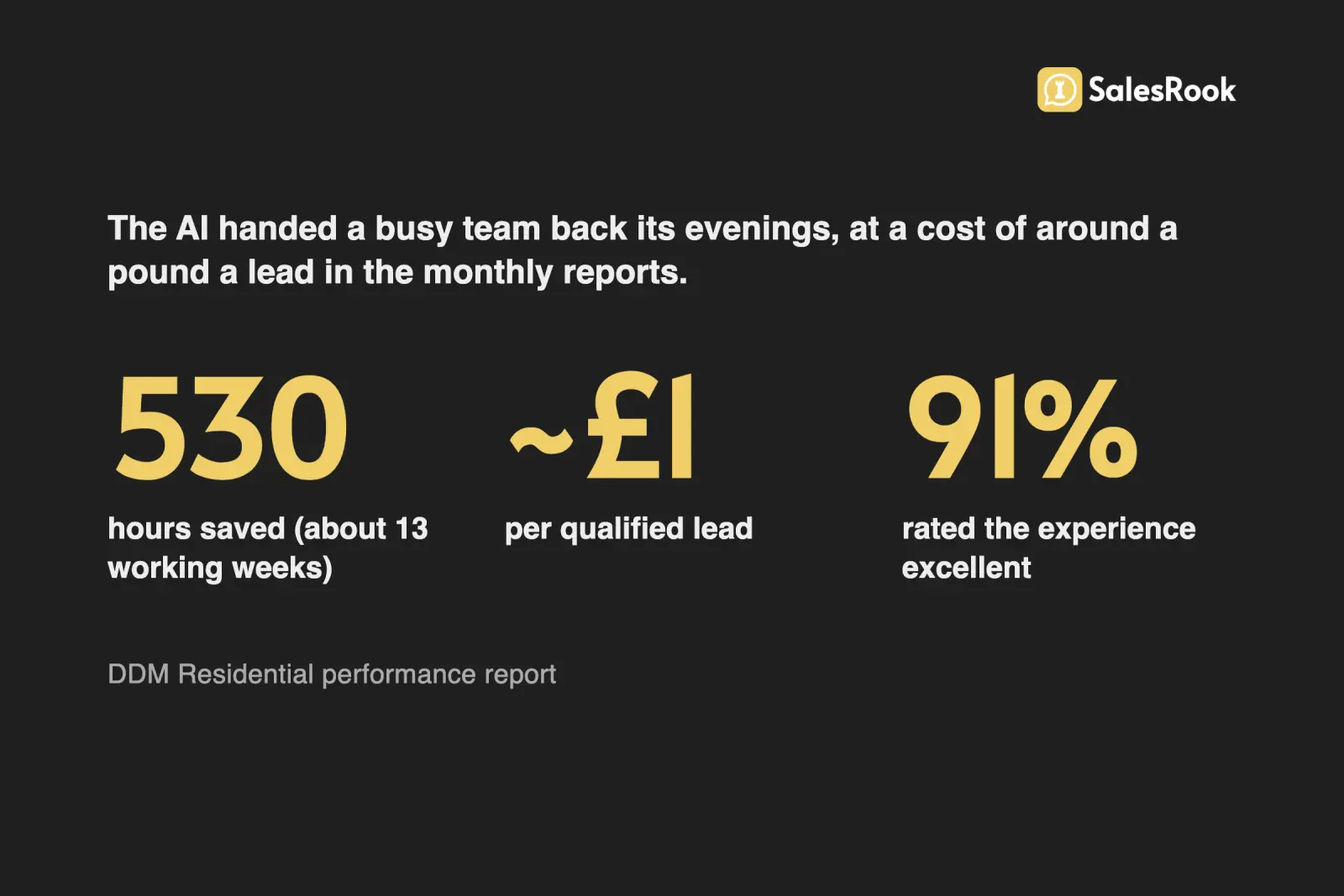
The valuation opportunities and the referrals are the headline, and they are the numbers a business owner remembers. But the quieter figure is the one that actually lets a small team keep going. Alongside all of that, DDM's report estimates the same work handed the team back 530 hours, roughly thirteen working weeks of evenings, weekends and repetitive first replies that nobody had to sit through. On the report's own salary-band basis, that time is valued at somewhere between roughly £8,800 and £14,700, though the honest way to think about it is not as cash banked but as hours a stretched team got to spend on the viewings and the offers instead of the triage.
530 hours saved, around £1 per qualified lead
DDM's monthly reports put the cost of a qualified lead at around a pound (59p to £1.08 across the months we checked). The valuation opportunities and mortgage referrals are the commercial upside. The hours are what let a busy team chase them.
The encouraging part is that answering at that scale did not seem to feel like a machine to the people on the other end. Across the period, 91% of Kelly's conversations were scored Excellent on the report's own sentiment analysis, which tells me most of them did not feel fobbed off by a bot.
That is the part I care about most, because the objection I hear more than any other is not "will it work". It is "we do not want a bot talking to our buyers like a bot". Quite right. The answer is not to leave the enquiries unanswered until Monday. It is to answer them well, at the moment they arrive, and I have written before about whether an AI has to sound robotic, which it need not.
None of it dropped into place on day one
I should be honest that this was not flicked on like a switch, because it never is. Getting Kelly to cover the after-hours calls through missed-call text-back meant untangling how DDM's sales and lettings lines were routed, and treating the two as separate offices.
The missed-call cover was not something we talked DDM into, for what it is worth: David asked us for it.
Early on, one of the team hit a snag where their WhatsApp threads were not syncing cleanly back into Reapit, their CRM, and our support team had to sit with them and work it through. That is the unglamorous part of any rollout, and it is worth saying out loud, because the numbers above are what you get after the setup, not instead of it.
The most honest account of those early months came from a senior manager on DDM's sales side, three months in, on an ordinary review call. Both halves in one breath:
"I think now we've turned SalesRook on, we're exceeding their expectations at 8 o'clock at night. They're like, oh, wow, they've responded. Amazing. Let's book the viewing now. But unfortunately, Kelly can't book the viewing at the minute because we're not geared up with that online viewing booking."
A senior manager on DDM's sales side, November 2025
I could have trimmed that quote after "amazing", and you would have been none the wiser. The second half is the truer half: an instant answer raises expectations, and the rest of your process has to rise to meet them. The team's early feedback said the same thing more bluntly, and working through it is what the first few months actually consisted of.
Anyone who promises you a clean switch-on is selling you the demo, not the rollout.
Do not take my word for any of it
I run SalesRook, so I am hardly a neutral witness to our own case study, and you should discount everything I have said accordingly. Which is exactly why it helps to hear it from the person who runs the firm rather than the person who sells the software. David Gardner sat down with the Relocation Agent Network, not with us, to talk about what actually changed across their first stretch with us. A figure in a chart is easy to dress up. The managing director of the firm, on camera, talking to his own referral network about his own results, is a good deal harder to fake.
David Gardner, Managing Director of DDM Residential, interviewed by the Relocation Agent Network.
And the version he gives when nobody is filming matches the one he gave on camera. In March, eight months in, in the middle of an ordinary support call about a browser extension, he told our team, unprompted: "We're finding the AI is working quite well, actually... It's doing what we need it to do. We're really happy with it." Unrehearsed, mid-call, about as far from a marketing shoot as it gets.
It is a small measure of how the period went that the Relocation Agent Network chose to put DDM's results in front of their own members. When your referral network starts using your numbers as the example, you are past the point of wondering whether the thing works.
What any agency can borrow
The lesson I actually want you to take is not "go and buy our software". It is that nothing DDM gained came from a bigger budget or a single new lead. It came from two decisions any agency can make, with us or without us. Answer enquiries fast, on the channel the buyer will actually reply on, and do it at nine on a Saturday night as readily as at nine on a Monday morning. Then read them properly enough to catch the valuation, the relocation and the mortgage cue hiding inside a plain question. The tools make that easier at scale. The choice to do it at all is yours.
David Gardner frames the target better than I can: "My whole thing with AI is I'm not looking to replace people. So for me, AI is there to enhance and make your teams better." That is exactly how the 530 hours read: the triage handed off, the people kept for the work that needs one.
So here is the cheapest experiment in estate agency, and you can run it this week without spending a penny. Pull last weekend's enquiries, the ones that landed after your office closed on Friday. Count how many got a reply before Monday morning. Then read the ten most recent ones all the way through, and mark every buyer who let slip that they also have a place to sell, a move out of the area, or a mortgage still to arrange. Whatever those numbers turn out to be, that is the size of your leak, sitting quietly in your own inbox. It is the same one DDM closed.
Back on that imagined Saturday night, the enquiry that would otherwise have slept until Monday gets a reply while the buyer is still on the sofa, and the seller hiding inside it gets noticed instead of lost. That is not a trick of the software. It is simply someone, or something, being there to answer at the moment it matters.
If you would rather see the size of your own leak than take DDM's word for it, that is the conversation we have with agencies every week. Bring us last weekend's enquiries and we will show you, on your own numbers, how many went unanswered and how many were quietly hiding a valuation or a mortgage. Kelly does not clock off, and the enquiries were always going to arrive whether anyone was there to answer them or not. The only question is who will be.

Max Hardy
Co-Founder
Max Hardy is the Co-Founder of SalesRook, a leading provider of AI solutions for the property sector. With a background in technology and property, Max leads SalesRook's mission to transform how estate agents and mortgage brokers engage with leads through AI-powered WhatsApp automation.