Everyone assumes that to win more instructions you need more leads. Bigger portal packages, another line in the marketing budget, a fresh burst of paid ads to make the phone ring a little louder. It is the most natural conclusion in the world. In my experience, it is also almost always the wrong one. The agency that grows is rarely the one that bought the most enquiries. It is the one that lost the fewest.
Which brings me to estate agent lead generation as it actually plays out on a Tuesday, and to Michael Poole, an award-winning family agency covering Teesside who liked their AI enough to give it a name: Elsie. This is a story in two chapters. The first month was fast: 12 instructions worth £28,500, at an 11:1 return. Then a year in, we sat down with their CRM and counted properly, and Elsie's on-patch work had surfaced 97 instructions and 40 completed sales, while, entirely separately, their off-patch referral log grew from 18 to 206. Same portals. Same Rightmove bill. Same team.
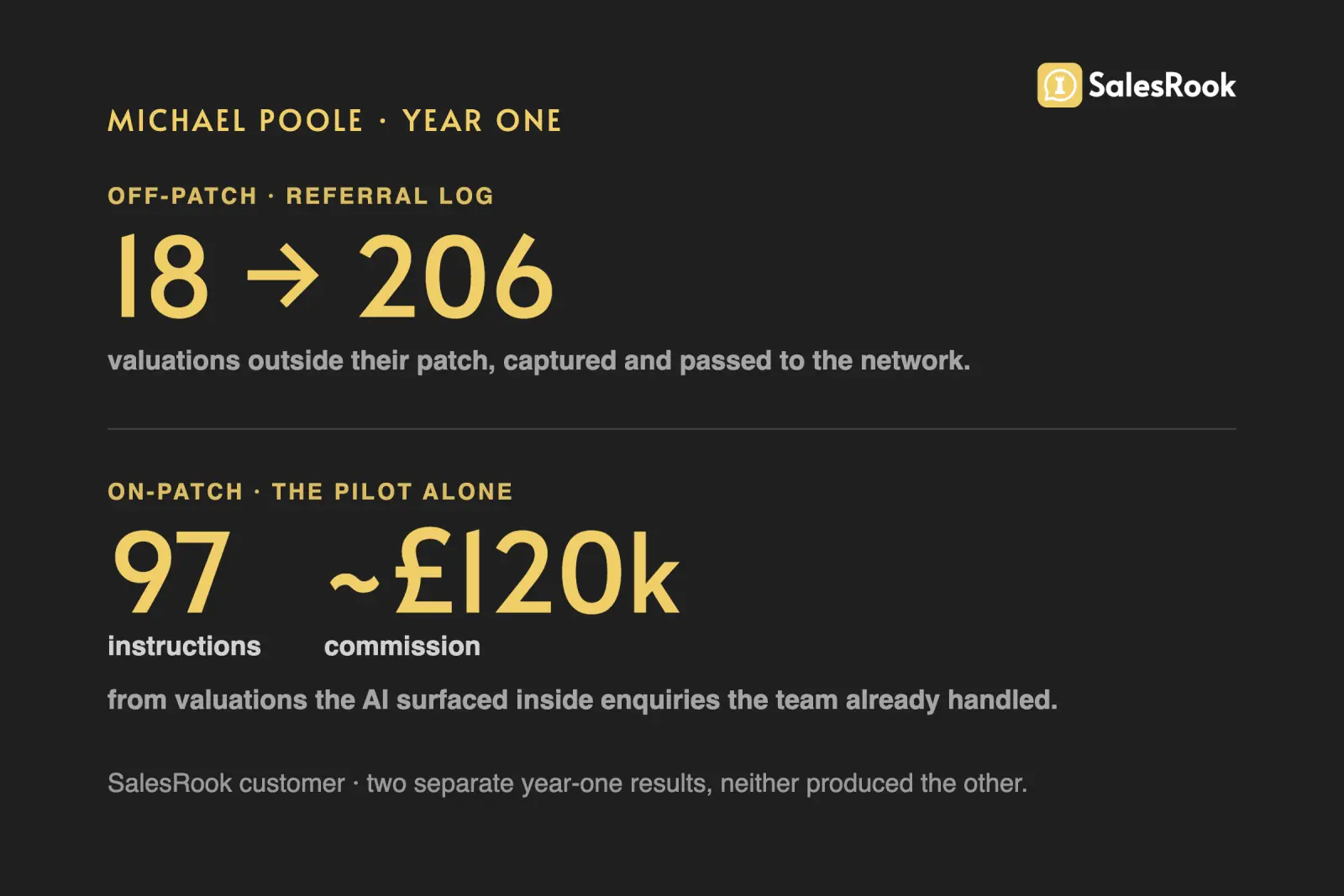
Two distinct year-one wins. The referral log went out to the network; the instructions came from enquiries the team was already handling. Neither produced the other.
It was never a lead problem
When we met Michael Poole, the leads were already arriving. What they had, like nearly everyone, was a quiet leak on the way out, not on the way in.
It is worth being honest about what that inbound stream costs. The average agency now pays Rightmove around £1,530 a month, and that number keeps climbing: the portal's revenue rose 9% to £425.1m in 2025 as agents and developers upgraded packages, added features and increased usage. Feelings about that are strong enough that a group of agents has filed a claim worth up to £1.5bn, alleging the fees are excessive and unfair. Nothing there is proven, and it may never be. But it tells you how much every enquiry already costs before anyone even replies to it.
£1,530 a month
is what the average agency now pays a single portal to make the phone ring. The money is not leaking on the way in. It leaks on the way out, in the enquiries nobody answers in time.
So when a director tells me they need more leads, I gently disagree. What most agencies need is to stop paying full price for enquiries they then let go cold. Michael Poole processed over 40,000 enquiries across the year. The interesting question was never how to get more of them. It was how many were quietly worth more than a quick "yes, still available", if only someone read them properly and in time.
The first month, before anyone had settled in
The year is the number I would plan a business on, and I will come to it. But it is never the first thing an owner asks me. The first thing they ask is how long before they see anything at all, which is a fair question when you have been sold a twelve-month journey before. So it is worth starting where Michael Poole started.
In their first month, Elsie read 600 sales enquiries and flagged 87 of them as carrying an on-patch valuation hiding inside, a discovery rate of 14.5%. The team went out and conducted 38 of those valuations, which is a 43.7% conversion, and won 12 instructions. All twelve completed, and between them they were worth £28,500 in commission: an 11:1 return on what Michael Poole spent with us that month.
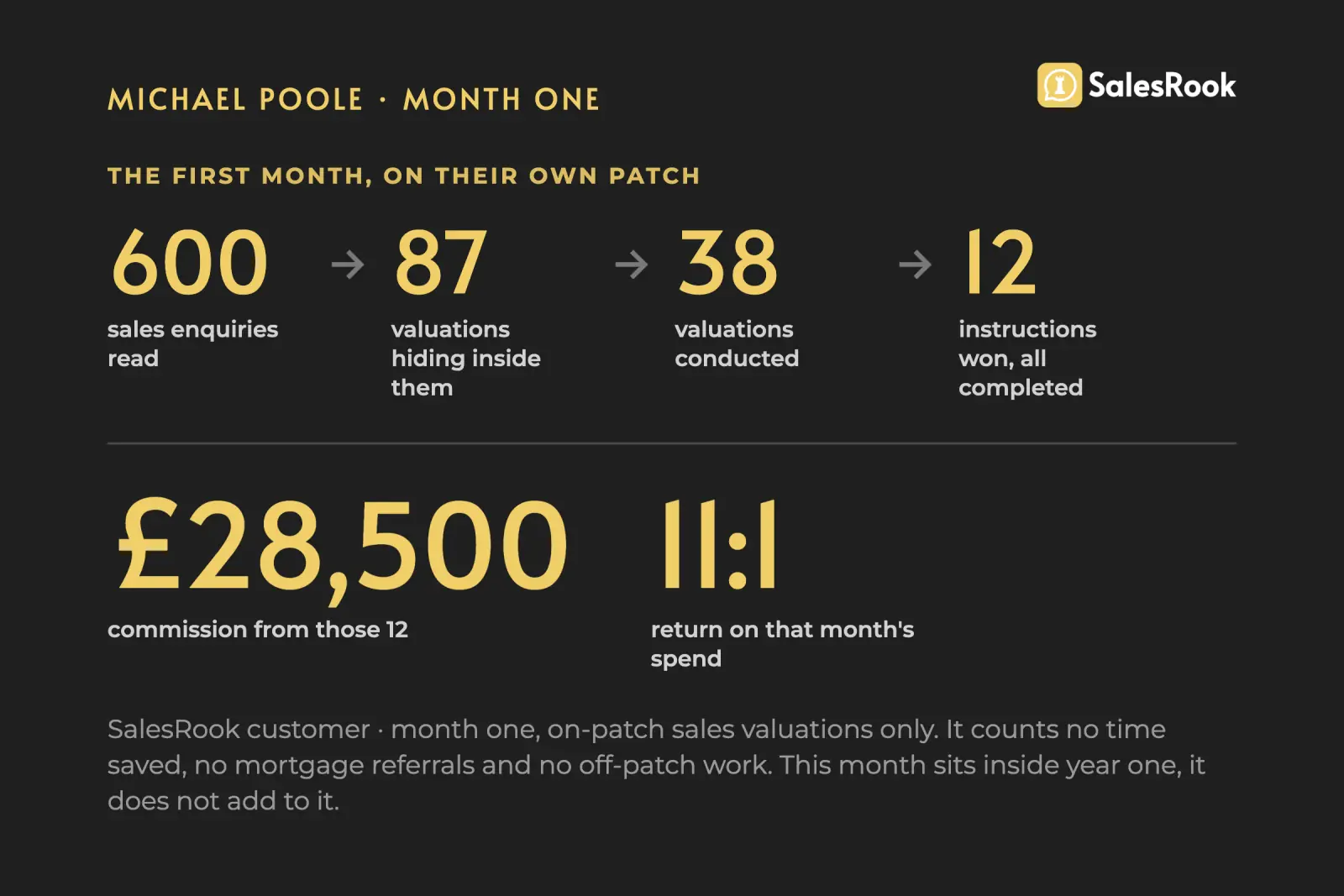
The first month. On-patch sales valuations only, so it counts none of the time saved, the mortgage referrals or the off-patch work.
Two things about that month, and they pull in opposite directions. It flatters us, and it also undersells us. It flatters us because one strong month is not an annual run rate, and because all twelve of those instructions completed, which is not what a normal year looks like anywhere. It undersells us because it counts on-patch sales commission and nothing else: not an hour of the time saved, not a single mortgage referral, not one of the off-patch moves.
Here is our own Richard Remington walking through that first month at the time, before any of us knew whether it would hold up. It is our read of their numbers, not their verdict on us. Rich himself is further down, on camera, talking about the year.
Richard Remington of SalesRook, walking through Michael Poole's first month at the time. Rich Poole's own interview is further down.
Which is exactly why we did not leave it there. A good first month is a good first month. It is not evidence, and I would not want anyone signing anything on the strength of it.
So we went and counted
I am wary of case studies that wave a big number at you and hope you do not ask where it came from. So this one was built the hard way. With Michael Poole's blessing, their team pulled a full year of property records straight out of their Reapit CRM, every sales valuation that became a registered property between November 2024 and October 2025. We then matched those records against Elsie's conversations by postcode, address, email and name, to see which instructions could be traced back to an opportunity the AI had surfaced inside an ordinary buyer enquiry.

Elsie flags the valuation hiding inside a buyer enquiry. Winning it is still the team's job, the same team, now pointed at the right conversations rather than hunting for them.
That is a deliberately conservative way to do it, and it cuts against us. We could only confidently attribute 22.8% of the year's valuations to a specific source at all, so the numbers below are the ones we can stand behind with a name and a postcode attached. The true figure is almost certainly higher. When I say Elsie surfaced 97 instructions, I mean 97 we can point to individually in their own CRM, not 97 we modelled.
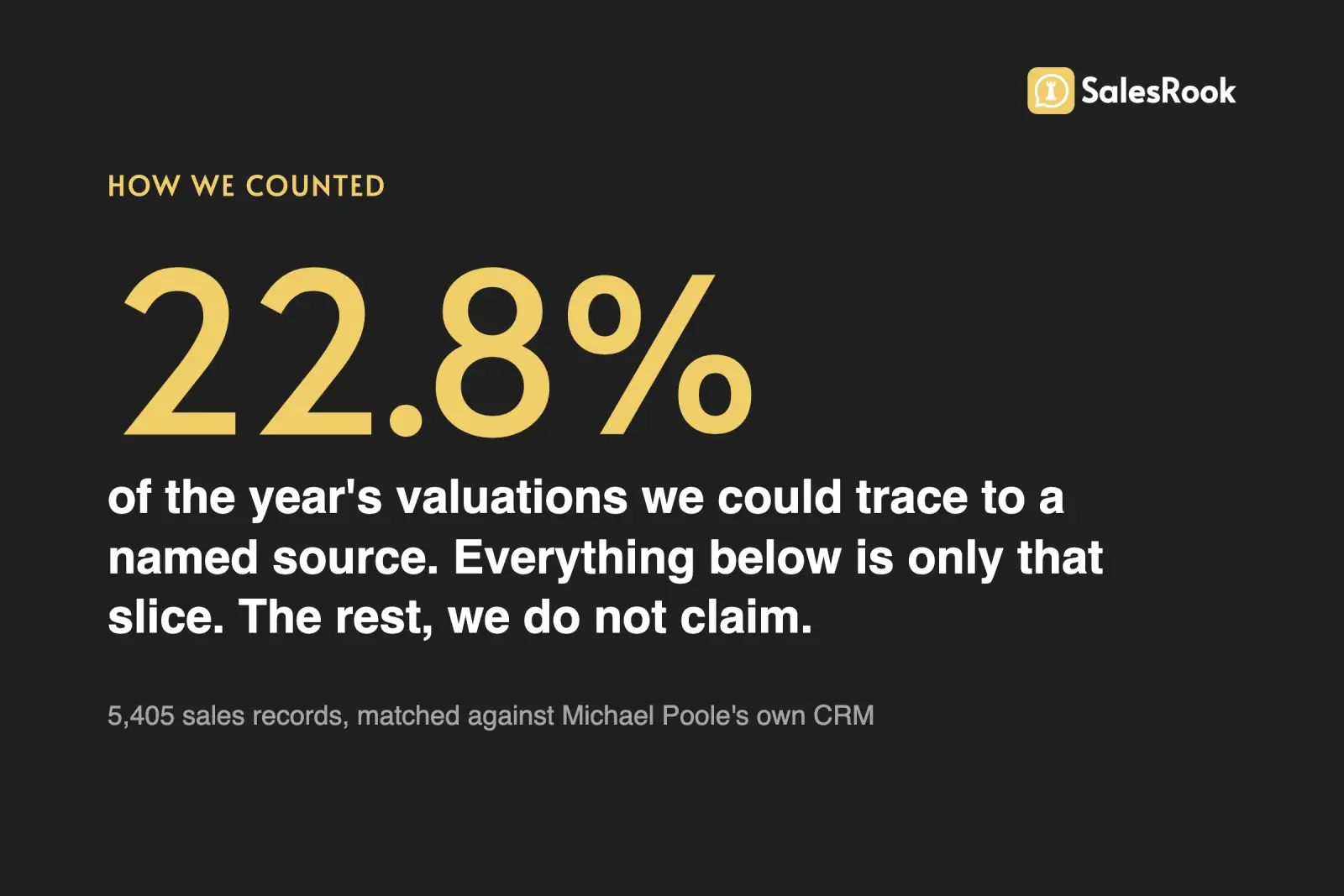
When we walked Rich Poole through the finished breakdown on a call, every source of the year's instructions counted side by side, the count was not built to flatter us and it did not: it also showed him that his own website, not Elsie, was his single biggest traced source of instructions. What stayed with me was his reaction to seeing it counted at all:
"Our website keeps telling us that our website's doing well. But when you haven't got a comparison, you don't know where the leads are coming from."
Richard Poole, Managing Director, Michael Poole
He runs an award-winning multi-branch firm, and even he could not see it without the count. This is the part I care about most, because it is the part most vendors skip. A result you can trace to a completed sale in the client's own system is worth ten you have to take on faith.
What a fast, well-read first reply is worth
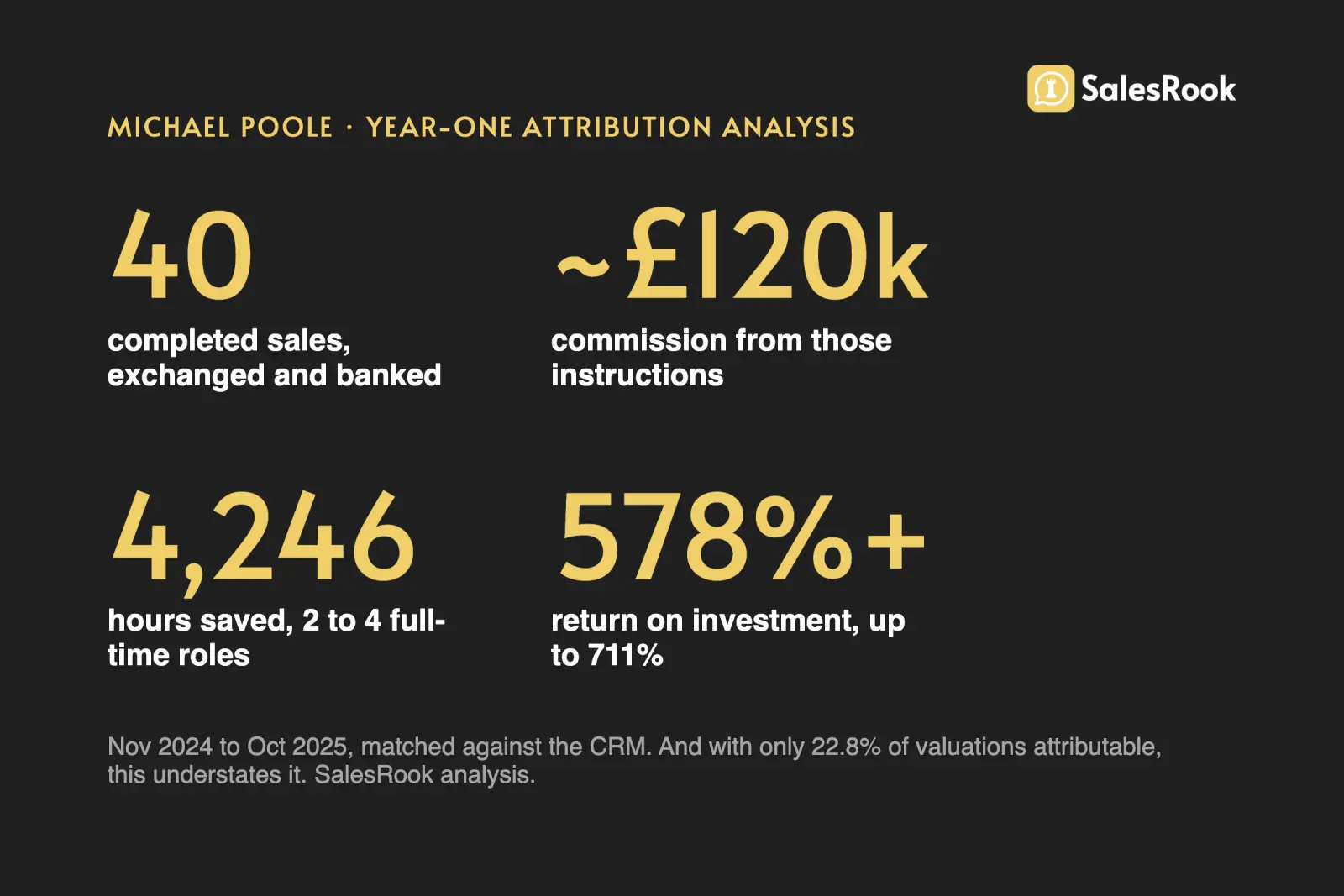
Here is what the count found. Inside the enquiries Michael Poole were already receiving, Elsie surfaced 370 sales valuations. Those became 97 instructions, and 40 of those have already exchanged and completed, banking over £100,000 in commission between them. A further 57 instructions were still working their way through the pipeline when we ran the numbers.
That commission figure is a floor, not a ceiling.
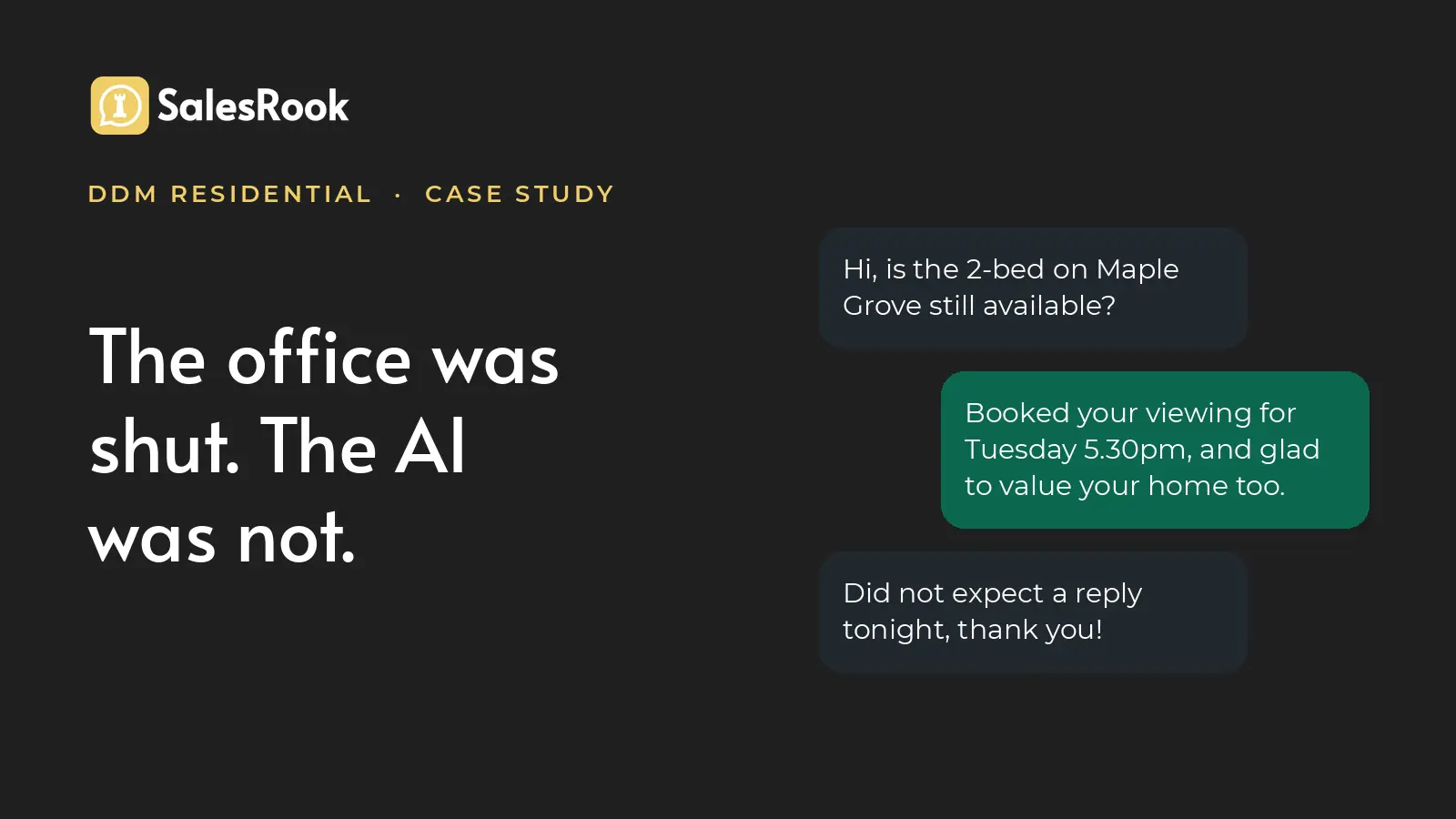
Sit with the shape of that funnel for a second, because it is the whole argument. These were not new leads. They were buyer messages the team was already paying the portals to receive. Roughly one in four of the valuations Elsie surfaced turned into an instruction, which is a serious conversion rate for messages most branches would wave through as viewing requests. Somebody asking about a two-bed flat may also have a house to sell, and they will mention it in passing if the conversation is warm enough to invite it.
Read past that and you have booked a viewing.
Read into it and you have found an instruction.
Speed is what makes the reading possible, because a buyer only opens up while their attention is still on you. That window is short and getting shorter. In a July 2026 Street Group survey of 1,830 sellers, 85% said they expect a reply within 24 hours, and sellers increasingly expect a same-day timescale. Across our own conversations, not Michael Poole's specifically, WhatsApp reply rates run close to 87%, against roughly one in five for email. The channel and the speed are half the answer. Reading the message is the other half.
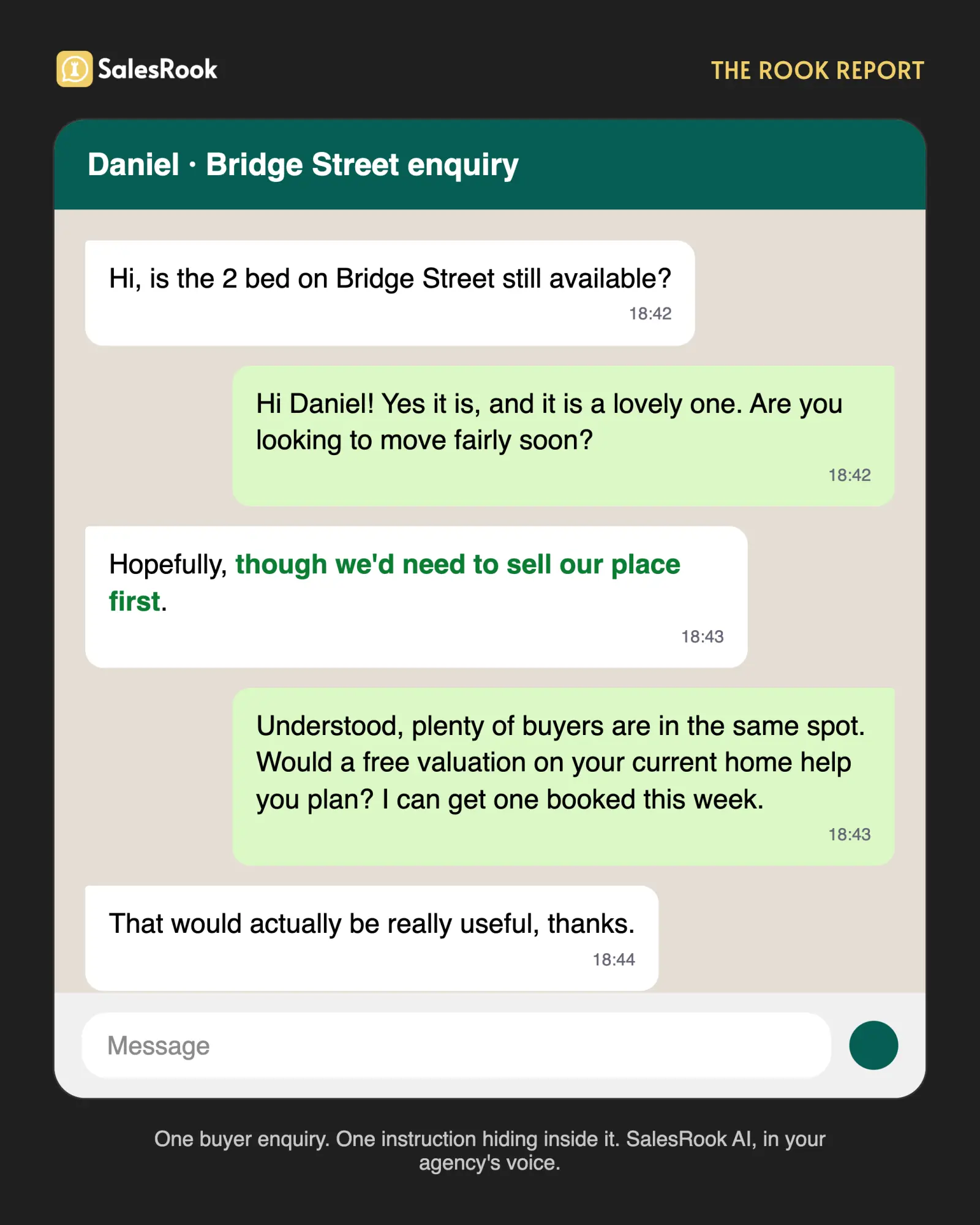
The valuation hides in plain sight. A buyer question that mentions a place to sell is an instruction waiting to be asked for.
The hours nobody puts on the board
The instructions are the headline, and they are the number an owner remembers. But the quieter figure is the one that lets a stretched team keep going. Across the year, handling that volume of enquiries automatically handed Michael Poole back 4,246 hours, the equivalent of two to four full-time negotiators they never had to hire.
Put those two things together and the picture is stark. On our analysis, the commission plus the time handed back worked out to a return of around 700% on what they spent with us. For context, in our analysis most investments in this sector land somewhere around 150% to 300%, with portal advertising at the top of that range and extra headcount lower still. This was several times that, and it cut the workload instead of adding to it.
Around 700% ROI
on our analysis, combining commission won with time handed back, in a sector where the same analysis puts most investments at 150% to 300%. The instructions are the headline. The hours are what let a busy team chase the next one.
Why the first month looks better than the year
You will have noticed those two returns do not match, and that the fast month looks better than the full year: 11:1 then, around 700% across the twelve months. I want to be the one to point that out, because a gap like that is exactly where a reader starts to suspect someone is quietly picking whichever number flatters them most. Three things are going on, and none of them is flattering.
The first is the window. One month was one month, and a strong one. The year includes the slow early weeks while Elsie was still learning their patch, their stock and their voice, and it includes every quiet month after. Ramp-up is real, and averaging it in is what makes a number durable rather than lucky.
The second is the arithmetic, and it is the important one. The first month sits inside the year, not alongside it. These are two counts of overlapping time, not two separate pots of money. Do not add £28,500 to the year's commission and imagine a bigger total, because I would be embarrassed if anyone quoted it back to me that way.
The third is that they measure different things. The 11:1 counted on-patch sales commission against one month's spend and stopped there. The year's return counts the commission and the hours handed back, across twelve months, and only against the 22.8% of valuations we could actually trace to a name. So: the month tells you how quickly this starts working. The year tells you what it is worth once the novelty has worn off. The second number is the one I would sign for.
This matters because the objection I hear most is not "will it work". It is "we are a phone-first firm and I do not want a machine getting between us and our clients". I have a lot of time for that, and I have written before about whether an AI has to sound robotic (it does not). The point of answering the overflow and the after-hours automatically is not to replace the call that builds the relationship. It is to make sure the call actually happens, instead of the enquiry sitting unread until the buyer has moved on.
The leads that were never theirs to lose
There is a second win here, and it is worth keeping strictly separate from the first, because it works in the opposite direction. Michael Poole are a member of the Relocation Agent Network, the invitation-only group of agents who refer buyers and sellers moving out of their area to a trusted local member somewhere else, and earn a share of the fee for doing it.
For most agents, out-of-area valuations are pure leakage. A buyer messages about a Teesside flat, mentions they are actually relocating to Bristol, and that opportunity simply evaporates, because nobody has the time to catch it and pass it on. Once every enquiry was being read properly, those moves stopped evaporating. Michael Poole's off-patch referral log grew from 18 in the previous year to 206, and it did so in only ten months. That is a tenfold jump in opportunities that used to walk straight out of the conversation, now caught and logged for the network instead, and not one of them cost a penny more in marketing.
Keep the two wins apart in your head, because they are genuinely unrelated. The 97 instructions were their own, won on their own patch. The 206 referrals were opportunities for other agents entirely. Neither produced the other. They are simply two different things that happen when you stop letting enquiries go unread.
Do not take my word for any of it
I run SalesRook, so I am hardly a neutral witness to our own case study, and you should weigh everything I have said accordingly. Better, then, to hear it from the person who runs the firm rather than the person who sells the software. When we sent Rich Poole the finished year-one analysis, his reply was short:
"Yes, I've got the report, some very big numbers in there!"
Richard Poole, Managing Director, Michael Poole
Numbers are one thing. Watching it work is another, and this is the part that matters more than any chart I can build. Here is Rich, in his own words, talking to the Relocation Agent Network about what changed across the year. A figure in an article is easy to dress up. A person who runs the firm, on camera, talking about their own results, is a good deal harder to fake.
Rich Poole of Michael Poole, on the Relocation Agent Network's own channel.
What you can borrow on Monday
Here is the lesson I actually want you to take, and it is not "go and buy our software". In fact, let me be plain about what software does not do. It will not create demand you never had, fix weak stock, or rescue a team that never follows up. All Elsie did for Michael Poole was answer their existing enquiries faster and read each one more carefully than a busy branch usually can at nine at night. That is a management choice long before it is a technology purchase, and you can make it this week, with us or without us.
So do not take the case study on trust. Go and run the cheapest possible version of it on your own numbers. Pull last week's enquiries and count how many got a reply within five minutes, how many within five hours, and how many are still sitting there unanswered.
Then read the ten most recent ones properly, all the way through, and make two separate marks. Mark every buyer who let slip that they also have a place to sell on your patch, and multiply that count by your average commission per instruction. Then, separately, mark every buyer moving out of your area entirely, because those are referrals, not instructions, and they are worth money too. Whatever those two numbers come to, that is the size of the leak sitting unread in your own inbox.
It is the same one Michael Poole quietly closed.
If you would rather not run the audit alone, that is the conversation we have with agencies every day, and I would far sooner show you the leak in your own numbers than sell you a mystery. Either way, run the count this week. The enquiries are already yours. You have already paid for them once. The only question left is whether anyone reads them.

Max Hardy
Co-Founder
Max Hardy is the Co-Founder of SalesRook, a leading provider of AI solutions for the property sector. With a background in technology and property, Max leads SalesRook's mission to transform how estate agents and mortgage brokers engage with leads through AI-powered WhatsApp automation.