Estate agent lead generation is the work of attracting property enquiries and turning them into valuations, viewings and instructions. For most UK agencies the hard part is no longer getting enquiries. You already pay for those, through the portals, your website and social ads. The hard part is answering them fast, qualifying them properly, and making sure not one goes cold while nobody is watching.
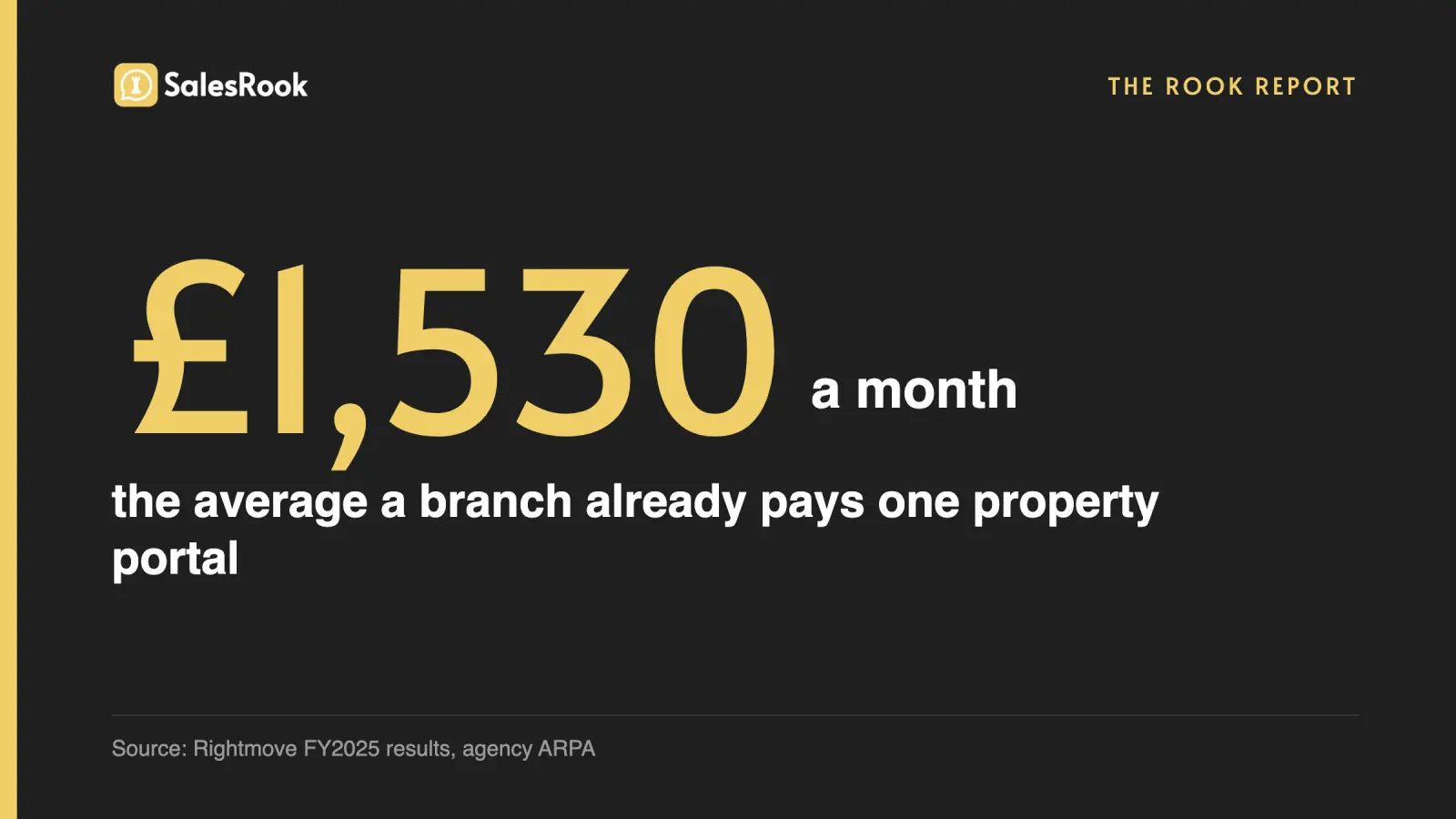
The average estate-agency branch in the UK now pays a single property portal about £1,530 a month. That is not a marketing estimate, it is the portal's own number: Rightmove's 2025 full-year results put agency revenue per advertiser at £1,530 a month, up 6% on the year, inside total revenue of £425.1m, up 9% (The Negotiator, reporting Rightmove's audited full-year results, 27 February 2026).
Sit with that for a second. North of £18,000 a year, from one branch, to one portal, spent entirely to make the phone ring. And here is the uncomfortable part: the money is not leaking on the way in. It is leaking on the way out, in the enquiries nobody answers.
Here is where it actually goes. Not on the way in, but on the way out. The enquiries are landing. They are just landing faster than a phone-and-email team can catch them, and a good share of them land in the evenings and at weekends, when there is nobody at the desk to try. The gap between an enquiry arriving and someone answering it is the whole of modern estate agency lead generation, and it is the thing agency owners most consistently underestimate about their own business.
I run SalesRook, and I spend most of my week talking to agency owners about exactly this. Most of them do not have a lead problem. They have a follow-up problem. This page is the playbook we walk them through, built on real numbers and deliberately honest about what works, what does not, and where the money leaks.
300,000+ enquiries a month
SalesRook handles more than 300,000 property enquiry messages every month for 1,500+ property professionals across 250+ estate agency offices, with WhatsApp reply rates approaching 87%. SalesRook internal data.
What estate agent lead generation really is
Lead generation is usually sold to agents as a supply problem: buy more leads, run more ads, plug in another portal feed. For most firms that framing is wrong, and expensively so. Here is the more useful definition. Estate agent lead generation is a two-part job: creating enquiries, and then converting those enquiries into booked valuations and instructions before a faster rival does. Almost every agency I meet is decent at part one and quietly haemorrhaging money on part two.
The reason is simple. A property enquiry is a perishable asset. It decays by the minute. So the agency that "generates the most leads" is rarely the one that spends the most on marketing. It is the one that responds first, qualifies best, and never lets a live enquiry go cold.
Why do estate agents lose leads they have already paid for?
Because the leads arrive when nobody is at the desk, and they arrive faster than a phone-and-email team can handle. The industry data on this is uncomfortable.
Sellers now treat a fast reply as the baseline. Street Group's July 2026 survey of 1,830 recent home sellers found 85% expect a response to a selling enquiry within 24 hours, and one in five said anything slower than four hours was simply unacceptable. Set that against the reality of a branch: roughly half of all enquiries arrive out of hours, in the evenings and at weekends, when the office is shut (SalesRook platform data).
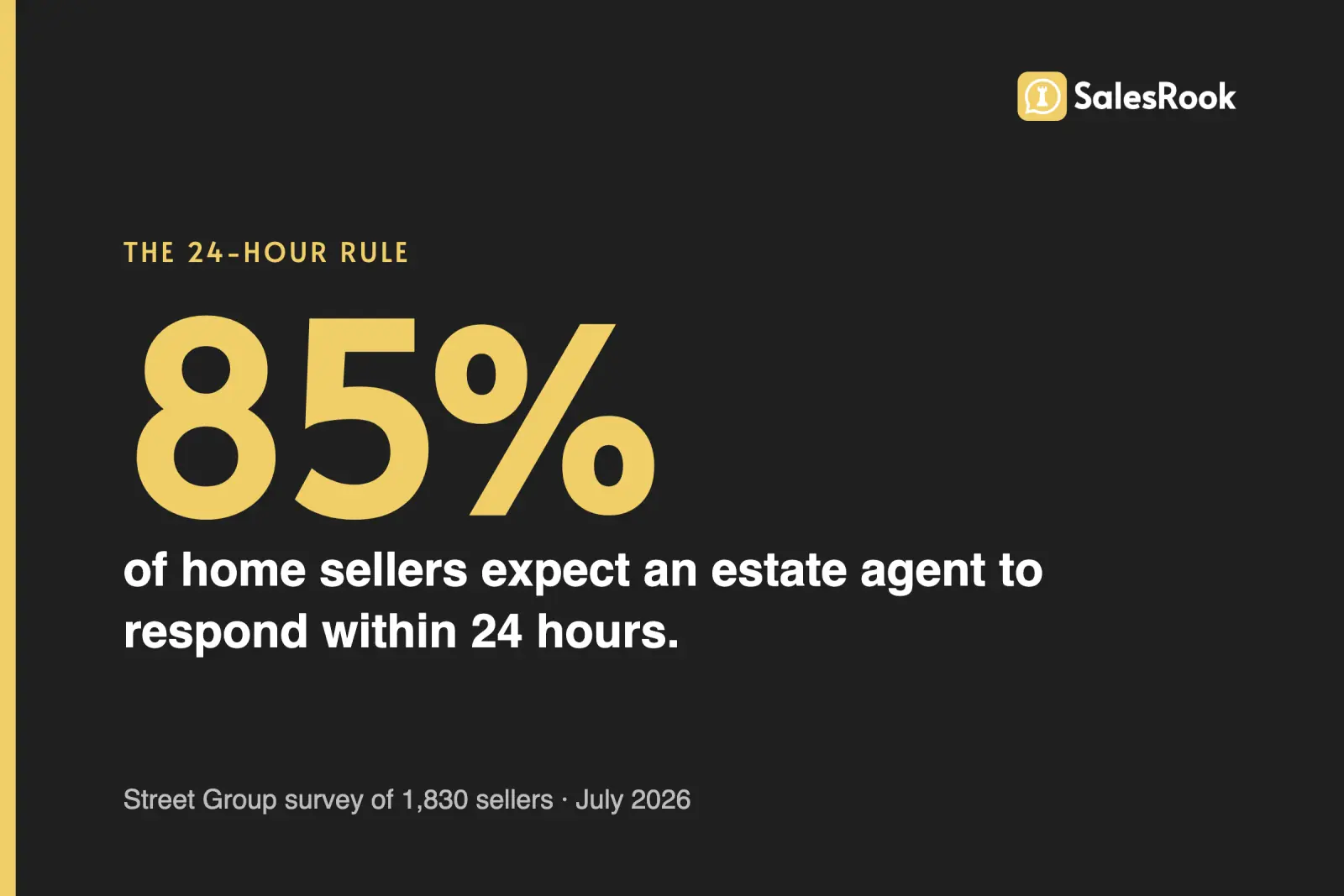
Put those two facts together and the leak is obvious. A large share of enquiries land when nobody is at the desk, and the first agent to answer has by far the better chance of winning the conversation. You are not being out-marketed. You are being out-responded.
You are not losing the lead because your marketing is weak. You are losing it because a faster agent answered while your branch was closed.
This is not a new discovery, it is just newly urgent. The classic Harvard Business Review lead-response study of US firms found that businesses which reached a new lead within the hour were roughly seven times more likely to have a qualifying conversation than those who waited even an hour longer. That was a 2011 study of American business-to-business sales, so treat it as the shape of the problem rather than a live UK figure, but the shape is exactly right, and messaging has only sharpened it. In our own platform data the pattern holds: the sooner a reply lands, the more likely the conversation goes anywhere at all, so a reply sent an hour later is worth a fraction of an instant one.
For an estate agent that maths is brutal, because a large share of your enquiries arrive exactly when your team is not there. A four-hour response window is not slow. In a competitive market, it is fatal. The property-specific version of this maths is unforgiving: much of the drop-off happens inside the first few minutes, so a reply sent even an hour later is competing for a conversation that has usually already happened somewhere else.
Where do estate agent leads actually come from?
Most agencies run some mix of five sources. Each has a different cost and, more importantly, a different failure mode.
| Source | The real failure mode |
|---|---|
| Property portals (Rightmove, Zoopla, OnTheMarket) | High volume, high cost. The leads convert poorly not because they are bad, but because they arrive in a flood and go unanswered. You pay premium rates, then lose a large share to response time. |
| Your own website | The cheapest lead you will ever get, and usually the most neglected. A "request a valuation" form landing in an inbox nobody watches after 6pm is a leak, not a lead source. |
| Social and paid ads (Meta, Google) | Good for top-of-funnel, but the leads are colder and evaporate without instant, patient qualification. |
| Your existing database | The single most under-worked asset in most agencies. Old enquiries, past valuations, dead portal leads. The return on reviving these is absurd, and almost nobody does it. |
| Referrals and vendor-applicant matches | The highest-intent leads you have, and the ones most often lost to "sorry, I forgot to ask." |
Across all five, the failure is the same: the enquiries exist, and the conversion machinery does not keep up. The regional mix shifts, but real estate lead generation across the UK breaks at the same point everywhere: the response layer, not the supply.
Should estate agents buy leads or generate their own?
Buying leads has its place, but as a primary strategy it is a treadmill. You rent the pipeline, the cost only ever goes up, and you never own the relationship. The portal-fee revolt underway right now is agents realising exactly this: a petition to the competition regulator points out that one portal controls over 86% of the time UK buyers spend on property portals, while one agent reported an 18% fee hike. It has gone further than protest: a collective claim worth up to £1.5bn has been filed at the Competition Appeal Tribunal, in which estate agents allege the dominant portal charged excessive and unfair fees. Nothing there is proven, and a certification hearing in November 2026 will decide whether it even proceeds, but the mood is unmistakable.
The better model, and the one I push hard, is extract more from the leads you already have before you spend a penny buying more. And agents are moving that way: Alto's 2026 Agency Trends Report found 52% of agents expect to use AI for lead generation and marketing this year.
This is not just SalesRook's view. The whole industry is working out, in public, where automation fits the lead flow. The UK's own agency body has been chewing it over on its podcast.
Propertymark Pulse: the UK's own industry body working out where AI fits the lead flow, and where the human stays.
The channel that makes speed actually pay: WhatsApp
Here is where the whole thing turns, and it is why we built SalesRook around WhatsApp rather than email or web chat. Speed is worthless if the reply lands somewhere nobody reads. The channel decides whether speed-to-lead pays off at all.
- Email. Open rates for lead follow-up sit around one in five. A fast email is still an email nobody opens until Tuesday.
- WhatsApp. Open rates are north of 90%, and people reply in minutes, often late at night from the sofa. Across our own platform we see open rates of 98% and reply rates approaching 87%.
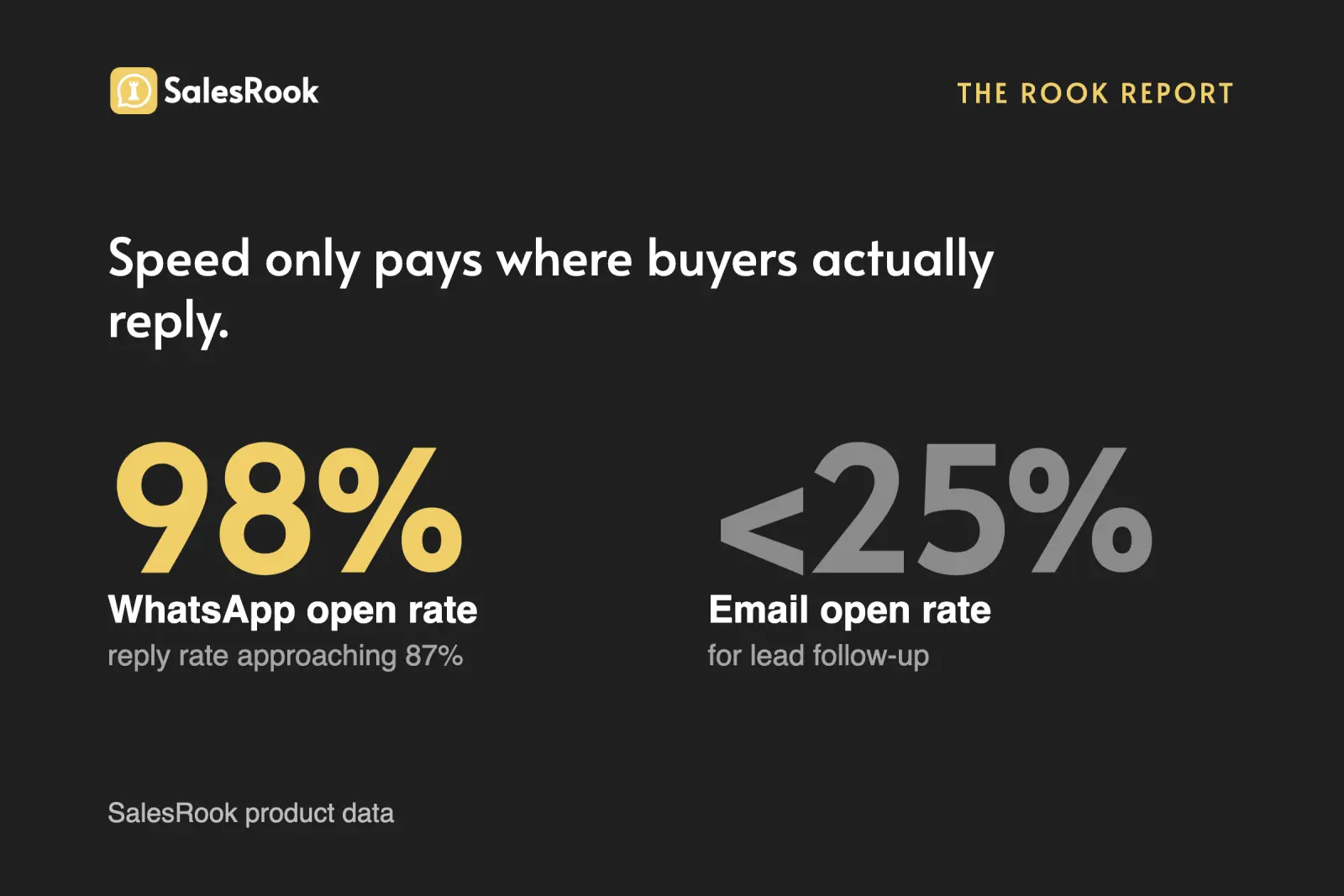
So an instant WhatsApp reply is not just faster, it lands on the one channel where buyers actually respond, and it can hold a real qualifying conversation in your agency's name: what they are looking for, their timeline, and, crucially, whether they have a property to sell.
That reply rate approaching 87% is a SalesRook product claim measured across our own client cohort, not a single client's audited result. But it is the number that changes the negotiator's morning. Instead of a cold list of names to chase, they open their CRM to structured summaries of every overnight conversation. They start from context, not from scratch. For the full mechanics of the channel, see our pillar on WhatsApp for estate agents.
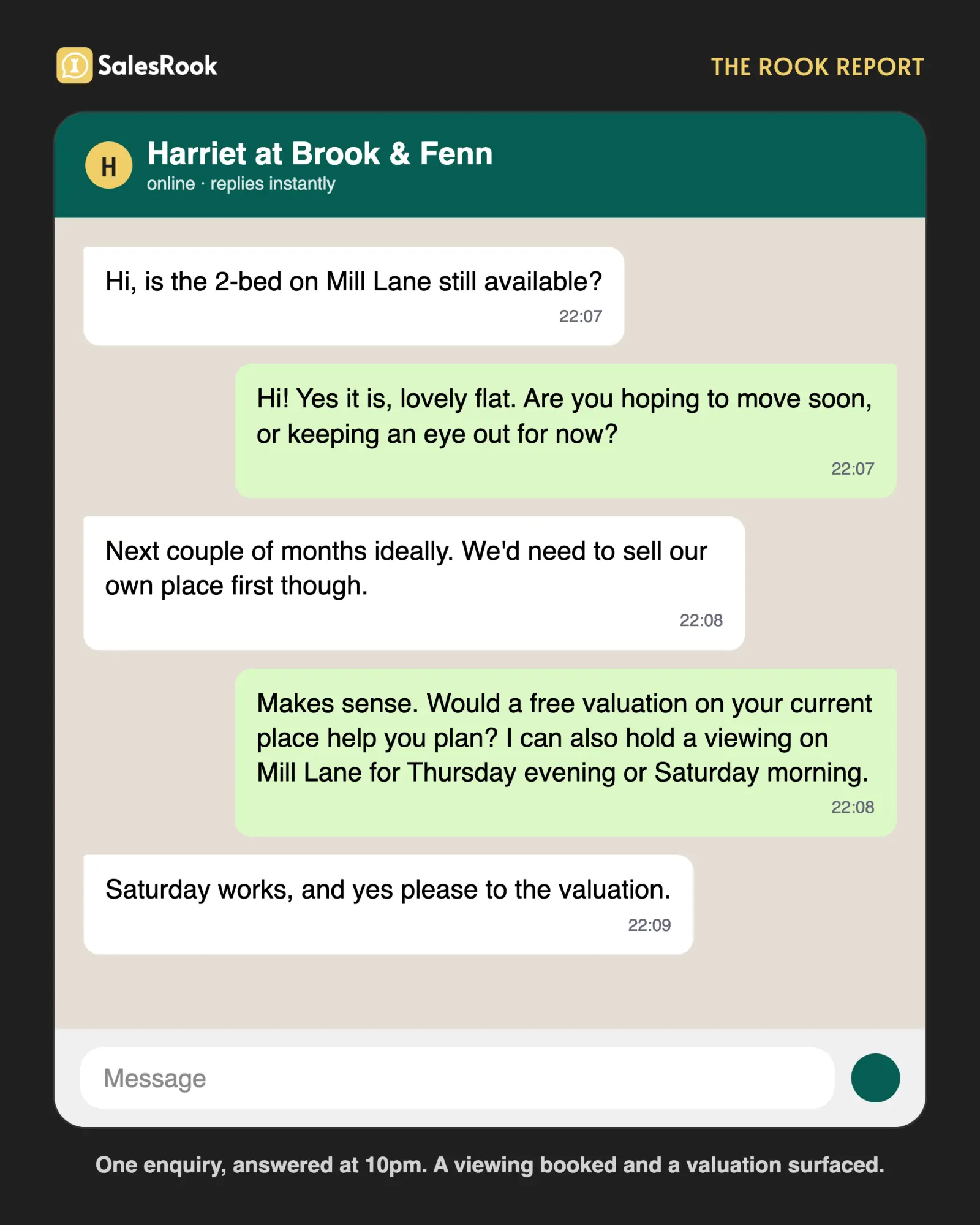
One enquiry, answered at 10pm. The AI qualifies, surfaces a hidden seller, and books the viewing before a rival has read their inbox.
The hidden gold: turning enquiries into valuations
This is the part most agencies miss entirely, and it is one of the highest-leverage moves in the whole playbook. A large share of your buyer enquiries are also sellers. They have a property to move, and if nobody asks, nobody finds out. In our data, more than one in five buyer enquiries contains a hidden valuation opportunity. The buyer filling in a portal form for a two-bed flat very often has a flat to sell first.
In a busy branch those opportunities die with a "sorry, I forgot to ask." An AI that qualifies every single enquiry, every time, without fatigue, surfaces them automatically. The most public proof of this is Michael Poole, the North East agency whose pilot with us was reported across the trade press. In year one, their pilot alone surfaced 97 instructions worth roughly £120,000 in commission, saved 4,246 hours of enquiry handling and cut their handling costs by 80%. Separately, and this is a different win, the same system captured valuations outside their own patch and referred them out through the Relocation Agent Network, growing that referral log from 18 to 206 in a single year.
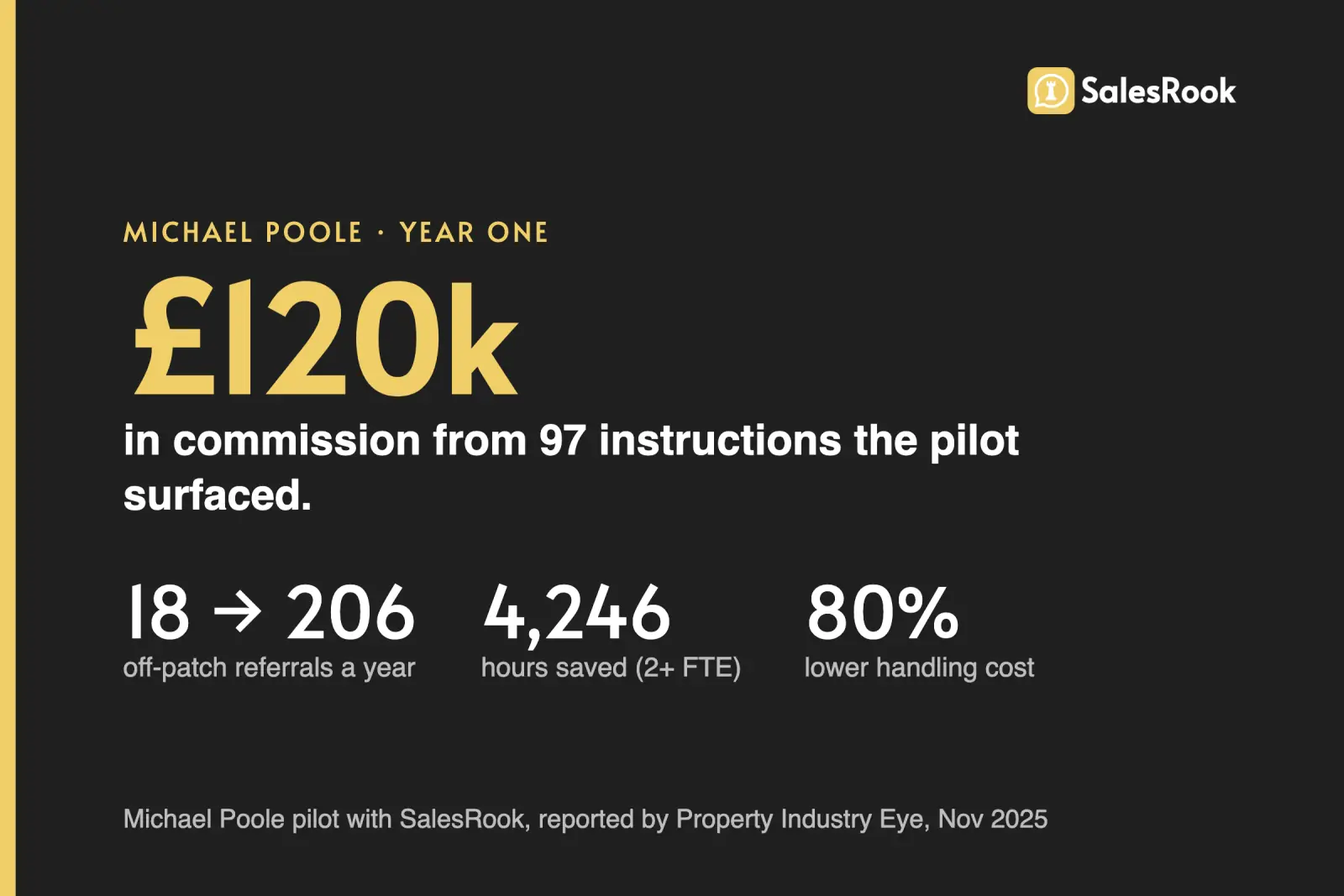
You do not need a pilot the size of Michael Poole's to see it work. An owner of a London lettings and sales agency went through the landlord leads already sitting on his own system, drafted a text with ChatGPT, and sent it himself one afternoon:
"I sent that text message out to like a ton of landlords and I got like a 50% response rate… off the back of it, I won like, I think four valuations, all of them instructed me."
An owner at a London lettings and sales agency
No platform, no campaign, no budget. That is the point. It was a list the firm already owned, sitting dormant, that produced four instructions from one message he wrote himself. It is the same discipline we cover in surfacing landlord leads for letting agents: the highest-value opportunity is very often already in your database, waiting for someone to ask. Before you buy a single new lead, that is the money on the floor. It is the difference between lead generation as a cost centre and lead generation as a growth engine: you are not just converting the enquiry in front of you, you are extracting the second and third opportunity hiding inside it.
Qualification, not volume: why 10 good leads beat 100 raw ones
More leads is not the goal. More instructions is the goal, and past a point, raw volume actively hurts you, because a flood of unqualified enquiries buries the good ones. Ten enquiries that turn into two instructions beat a hundred that turn into one, every time, because the hundred also cost your negotiators a week of calls to discover that ninety-eight of them were never moving.
Good lead generation is a filter, not a firehose. The job of the qualifying conversation is to sort the ready-to-move from the just-browsing, so your negotiators spend their hours on the enquiries that actually convert. That is what AI lead qualification for estate agents does: it talks to everyone instantly, without fatigue, and puts the conversations worth your team's time at the top of the pile, with the context already gathered. That is exactly the probing a tired human quietly stops doing at 5pm on a Friday.
Compliant by design: lead generation the regulator will not punish you for
Speed and scale mean nothing if they create a compliance liability, and in 2026 that risk is real. The obvious shortcut, negotiators messaging clients from their own personal WhatsApp, mixes client data into a private account the business does not control. Enough operators see that risk clearly that they have taken a formal position on it. A director at a large multi-branch group set out his firm's rule to me plainly:
"There's no business facility to use it. And from a GDPR perspective, they can't be using their own personal WhatsApp accounts for clients."
A director at a multi-branch estate agency group
Where that rule is not set, the conversations sit on a private phone with no trail, and they walk out the door when that person leaves. The second question every serious operator asks follows straight on: who picks the message up, and where does the trail live? Meanwhile response-logging is drifting from nice-to-have towards a statutory expectation, particularly in lettings under the Renters' Rights Act 2025, whose main provisions come into force from 1 May 2026 and are enforced by local councils, with civil penalties up to £40,000, not by the Information Commissioner's Office.
Done properly, a managed system fixes this: every conversation is logged, timestamped and retained on the business's own account, and access can be revoked the moment someone leaves. The negotiator moves on; the history stays with the business. Compliance stops being a tax on doing lead gen and becomes a reason to do it this way. GDPR done right is a sword, not just a shield.
Does automating your lead generation replace the agent? No, and it should not
The fear I hear most is that instant, automated contact makes an agency sound like a machine and cheapens the very relationship it is built on. It is a fair worry, and the industry's own leaders share it. Propertymark chief executive Nathan Emerson has put it plainly: buying or selling a home is still an incredibly personal process. Even as headcount softens under automation, industry leaders are clear the human element stays essential.
They are right, and the answer is not to automate the relationship. It is to automate the admin and the after-hours, and to hand the relationship, the valuation, the viewing, the negotiation, back to your people with the groundwork already done. Keep the human exactly where a human changes the outcome.
I will be honest about where this has bitten us. One independent agency nearly switched us off in the first month, because a senior negotiator felt an instant automated reply took away the personal first contact that made the firm what it was. He was not wrong, and we did not argue. We moved them to a hybrid instead: their people lead during office hours, and the AI only covers the evenings, weekends and the overflow that breaks every busy branch.
There is a cost we choose to carry too: our AI tells a customer it is an AI if they ask it directly, and that transparency measurably lowers our own conversion by a few points every month. We pay it on purpose, because getting caught pretending is far more expensive than the points you save by pretending well. For the wider view of how this fits an agency, see AI for estate agents.
Automation does not replace the agent. It just means a faster reply wins the conversation before a rival opens their inbox.
How to measure estate agent lead generation: cost per outcome, not cost per lead
If you take one thing from this page, take this: stop measuring cost per lead, measure cost per outcome. Cost per lead flatters the wrong strategy, rewarding cheap volume and ignoring the conversion leak. Cost per booked valuation, cost per instruction, cost per referral: those are the numbers that tell you whether your lead generation actually makes money.
£128 versus £38 an answered lead
Take that £1,530-a-month portal bill against 100 enquiries, of which, realistically, 12 get a genuine reply inside the hour. On a cost-per-lead basis you tell yourself each lead cost £15. On a cost-per-answered-lead basis, the truth, your real number is roughly £128. Get an instant-response layer answering 40 of those 100 instead and the same bill works out at about £38 an answered lead. The spend never moved. Your response did. Illustrative figures.
When you re-frame around outcomes, two things happen. The dead database becomes your cheapest source. And the "expensive" instant-response layer starts to look worth testing, because it acts on every lead you already pay for, rather than piling more leads on top. The agencies pulling ahead right now are rarely the ones with the biggest marketing budget. They are the operators extracting more instructions from the same enquiry flow.
Do the maths on your own enquiries, before you pay anyone
I would rather teach you to find this money than sell you anything, so here is an audit you can run this week with a spreadsheet, no budget, and any tools you already own.
- Pull your last 100 portal enquiries. Mark how many got a real reply within the hour, and how many landed after 6pm or at a weekend. That second number is usually close to half. That is your out-of-hours leak, in black and white.
- Cost the ones that went cold. Take the enquiries that waited more than four hours or never got a proper answer, and multiply that count by the average fee on an instruction. That is not a marketing cost. It is money you already paid to acquire, and then dropped.
- Count the seller question you never asked. In our data more than one in five buyer enquiries hides a vendor. Go back through those 100 and count how many you actually asked "do you have a property to sell?" The gap between that number and twenty is your hidden valuation pipeline.
Do that honestly and the business case makes itself, whether you fix it with SalesRook, a rival tool, or simply a stricter human follow-up rota. The point is not the software. The point is that the leak is measurable, it is large, and it is sitting in a spreadsheet you already own.
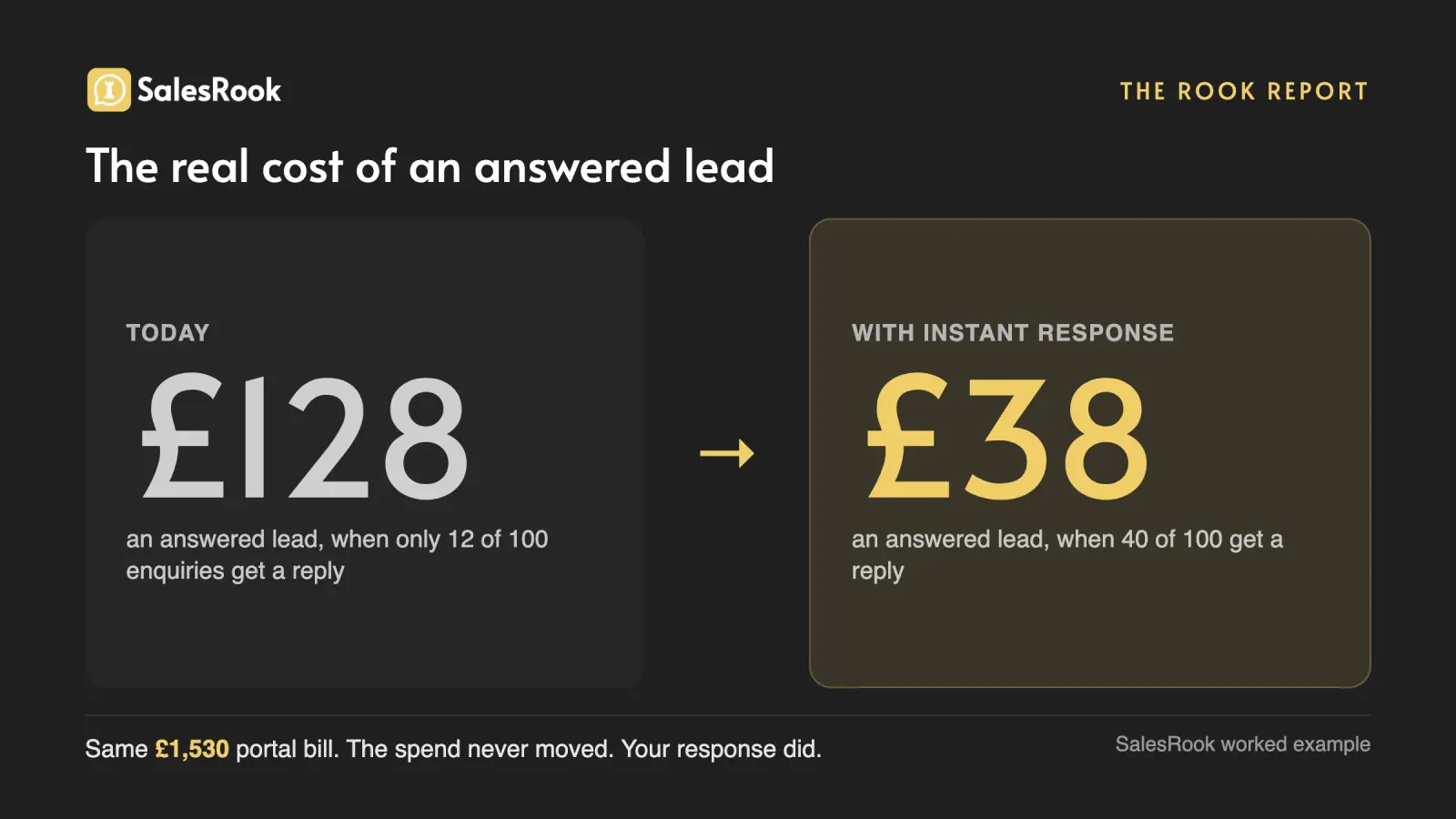
The spend never moved. The response did. That is the whole cost-per-outcome argument in one sum.
Frequently asked questions
What is estate agent lead generation?
Estate agent lead generation is the process of attracting property enquiries and converting them into valuations, viewings and instructions. In practice the decisive part is conversion, not supply: most agencies already receive enough enquiries and lose them to slow or missing follow-up.
What is the best source of leads for estate agents?
Usually your existing database and website, not more paid portal leads. Reviving written-off enquiries and instantly answering website forms typically beats buying new leads on cost per outcome.
How fast should an estate agent respond to a lead?
As close to instant as possible. Engagement drops the longer a lead waits, and when a prospect is contacting several agents at once, the first to respond is far more likely to get the qualifying conversation. Street Group's 2026 research found 85% of sellers expect a reply within 24 hours as a bare minimum, and any response measured in hours is effectively too late in a competitive market.
Should estate agents buy leads or generate their own?
Buying leads works as a supplement but not as a foundation. Owning your lead channel, and extracting more from the enquiries you already pay for, is cheaper, compounds over time, and is not exposed to ever-rising portal fees.
Does automating lead generation replace estate agents?
No. The most effective model automates the admin and the after-hours response, then hands qualified conversations to human agents for the valuation, viewing and negotiation. The consensus, including Propertymark, is that AI supports the agent rather than replacing the human element.
How do I measure whether my lead generation is working?
Measure cost per outcome, per booked valuation or instruction, not cost per lead. Cost per lead rewards cheap volume and hides the conversion leak where most agencies actually lose their money.
Ready to convert the leads you already have?
The enquiries are already arriving. Tonight's are already going cold. Estate agent lead generation, done the way the agencies pulling ahead do it, is mostly about responding first, qualifying every enquiry, and never letting a live lead go cold.
If you want to see what your own enquiries would sound like handled this way, book a 30-minute strategy session and I will show you what is working for agencies like yours, or see how it works first.
Max Hardy is Co-Founder of SalesRook, the AI-powered WhatsApp platform that helps 1,500+ UK property professionals, including estate agents and mortgage brokers, respond to every enquiry in seconds across 250+ offices.

Max Hardy
Co-Founder
Max Hardy is the Co-Founder of SalesRook, a leading provider of AI solutions for the property sector. With a background in technology and property, Max leads SalesRook's mission to transform how estate agents and mortgage brokers engage with leads through AI-powered WhatsApp automation.