Two messages land in a lettings inbox at nine in the evening, seconds apart, and on the screen they are identical. The first is a tenant asking whether the two-bed on Mill Road is still available. The second is a woman who has just inherited her mother's flat and is quietly wondering what on earth to do with it. Same grey bubble, one sitting above the other, both waiting, two of the leads you already pay for. In the branch accounts, though, one of them is worth a penny and the other is worth a pound. By morning the team will have answered whichever happened to be on top, and got on with the day.
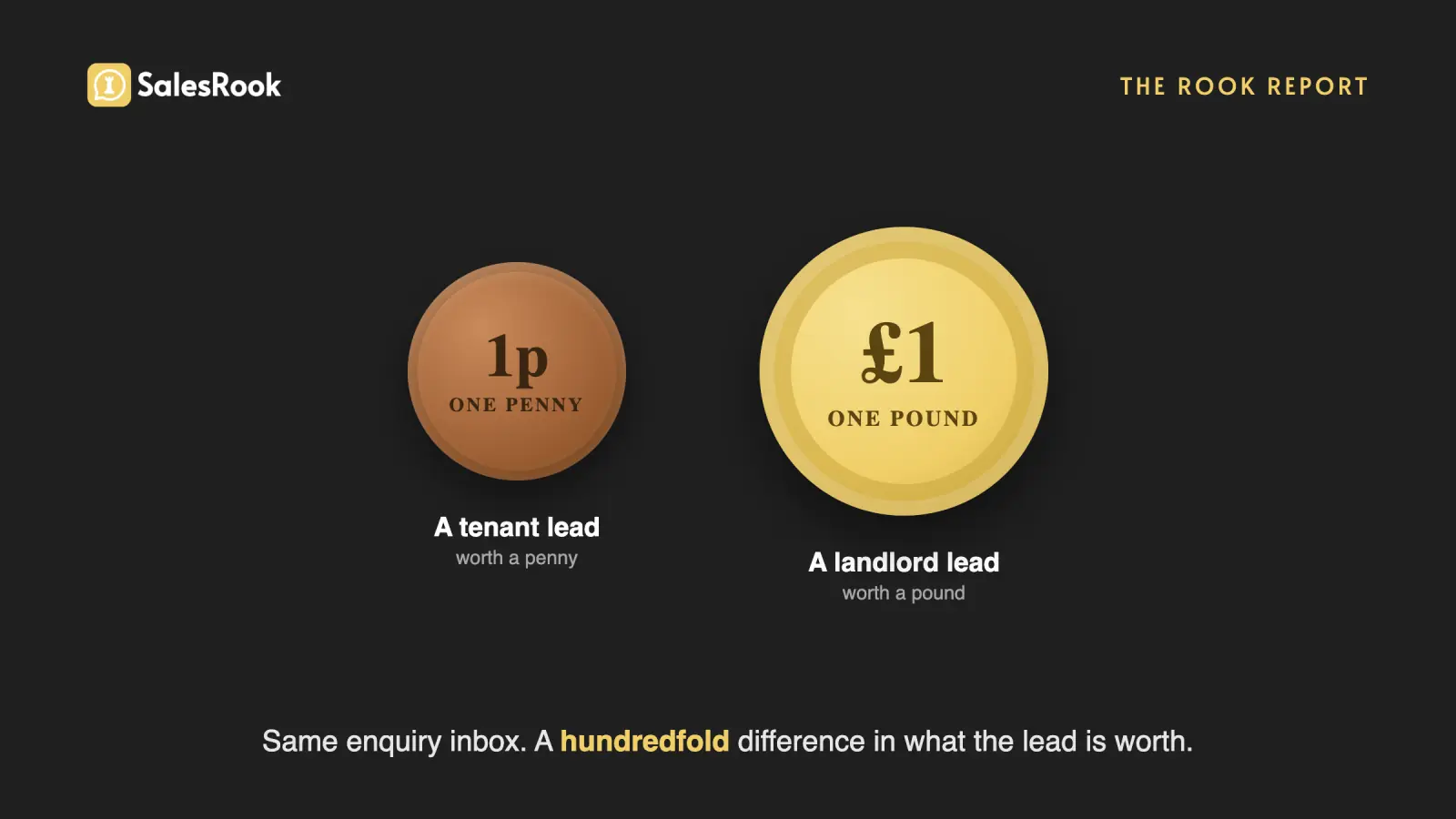
I did not invent that penny-and-pound split. A lettings director who runs a multi-branch London agency put it to me in almost exactly those words a few weeks ago, and I have not been able to put it down since. If he had to price the two enquiries that land on his desk all day, he said, a tenant lead would be worth about a penny and a landlord lead would be worth a pound. He has handled enough of both to know he is right. One good landlord relationship can mean years of managed income, and often a sale instruction down the line. A tenant is a single let. Same conversation on the surface, wildly different value underneath.
Here is the uncomfortable part. Most letting agents pour almost all of their energy into the penny and let the pound walk straight past the front desk. Not because they are lazy, but because the landlord is hard to see. He is hiding inside a stream of tenant enquiries, and nobody has the hours to go looking. Which is why surfacing landlord leads out of an inbox you already own is, to my mind, the single highest-value thing a lettings arm can automate this year.
Why this suddenly matters more than it did last year
The Renters' Rights Act 2025 came into force on 1 May 2026, and you have felt it already. Section 21 is gone. Every assured shorthold tenancy has converted to a periodic one, so fixed terms no longer exist. Rent can be raised only once a year, to market rate. And Awaab's Law, the statutory clock on serious hazards like damp and mould that already binds social landlords, is being extended to privately rented homes next, so the compliance load is only going one way.
All of that is real work. But the line that should worry a lettings principal most is the quiet one about money. The tidy renewal fee that used to land every twelve months has gone, and it is not coming back. When every tenancy is periodic, there is no fixed term to renew, so there is no renewal event to charge for.
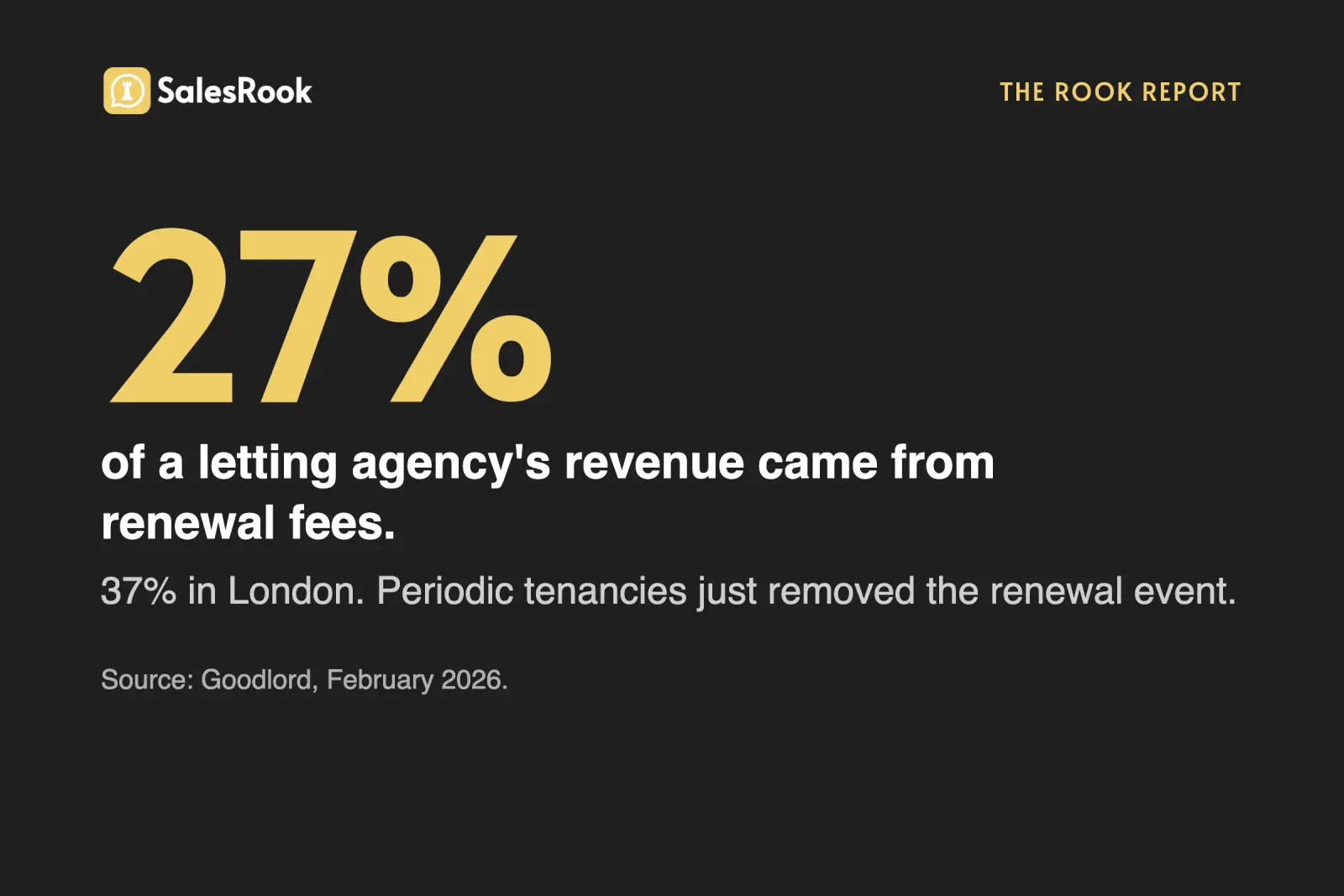
That is not a rounding error in the accounts. Goodlord puts renewal fees at an average of 27% of a letting agency's revenue, rising to 37% in London. Put your own number to it. On a lettings book billing £400,000 a year, 27% is £108,000 you now have to find again from somewhere else, and closer to £148,000 if you are a London office. A quarter to a third of the top line, removed by statute, on a single day in May.
So one obvious response, pushed hard across the industry right now, is to replace lost renewal fees with service packages. Compliance admin, inspection regimes, hazard-timescale tracking at portfolio scale. That is sound advice, and I would not argue with a word of it. But it quietly skips a step. You do not just need a new product to sell. You need more landlords to sell it to.
And landlords have rarely been scarcer or more valuable. The private rented sector has just had its largest decline this century, with Savills valuing the drop at around £48bn in 2025 alone as landlords sell up. Every landlord who stays is worth fighting for, and every landlord who is quietly weighing whether to let a second property is a genuine instruction waiting to be won. The fastest source of those new landlords is usually not a cold prospecting list. It is the conversations you are already having, and mostly wasting.
The landlord is already in your inbox
Think about who actually messages a lettings branch on any given evening. Tenants looking for a place, yes, by the hundred. But also the accidental landlord who has just inherited a flat, the couple moving in together who now have a spare property to let, the tenant who is quietly a landlord somewhere else, and the investor testing whether you are any good before he hands over a portfolio.

Every enquiry a branch answers is a chance to notice the pound in the pile. The trouble is noticing it on every enquiry, all day, without fail.
Every one of those is a pound hiding behind a penny enquiry. The problem is that a busy branch treats them all identically, because in the first thirty seconds of a message you genuinely cannot tell them apart. So you answer the ones you can reach, you miss the ones you cannot, and the landlord in the pile never gets asked the one question that would have surfaced him.
That question is not complicated. It is a light, natural, in-the-flow "do you currently let a property yourself, or are you thinking about it?" The trouble is that asking it consistently, on every single enquiry, day and night, is beyond what any human team can sustain. So it does not get asked. And the pound walks. Noticing it reliably, on the enquiries your team never reaches, is exactly the job that modern letting agent software should be doing while you sleep.
Why the cold landlord blast does not work
The instinct, the moment you realise you want more landlords, is to go and shout at all of them at once. Load your database of past landlord contacts, fire off a broadcast, and wait for the phone to ring. I want to save you the disappointment, because we have watched this pattern up close. In the cases we have reviewed, a mass landlord broadcast is one of the weakest tools in the box.
We sat down with one agency and reviewed a broadcast that had gone out to roughly 1,100 landlord contacts. It produced a healthy-looking 155 unique clicks on the link, the kind of number that looks fine in a report. The number who actually came back, replied, and started a real conversation was a tiny fraction of that. The agent's own honest reaction was that something must have gone wrong with the send. It had not. That is simply what a cold blast does.
It is not a failure of effort. It is a failure of context. A cold "are you a landlord who wants a valuation?" asks a busy person to raise their hand for no reason, at a moment when they were not thinking about you at all. Most people scroll straight past it, exactly the way you scroll past yours.
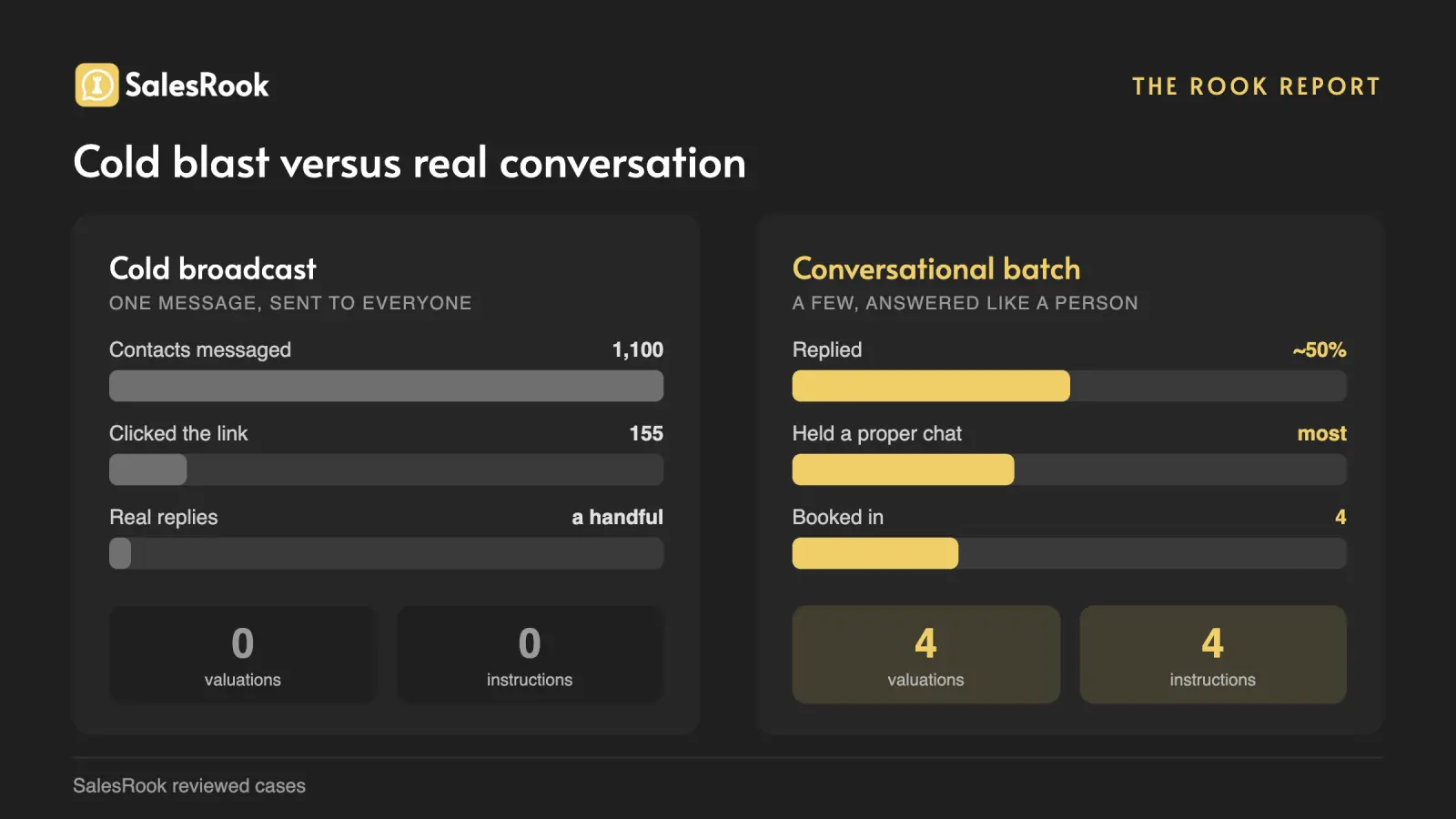
The same list, worked two ways. A cold blast to 1,100 contacts against a small, well-timed conversational batch. SalesRook reviewed cases.
What actually surfaces the landlord: a real conversation, at the right moment
Now hold that flat broadcast up against the opposite approach. An owner at a London lettings and sales agency told me he had gone through the landlord leads already on his own system, drafted a short message with ChatGPT offering a two-minute chat, and sent it himself to a small batch, framed as a chat rather than a shout. He put the response rate at around 50%, and reckoned it produced four valuations, every one of which instructed him. That was his own outreach, not a platform campaign, which is rather the point.
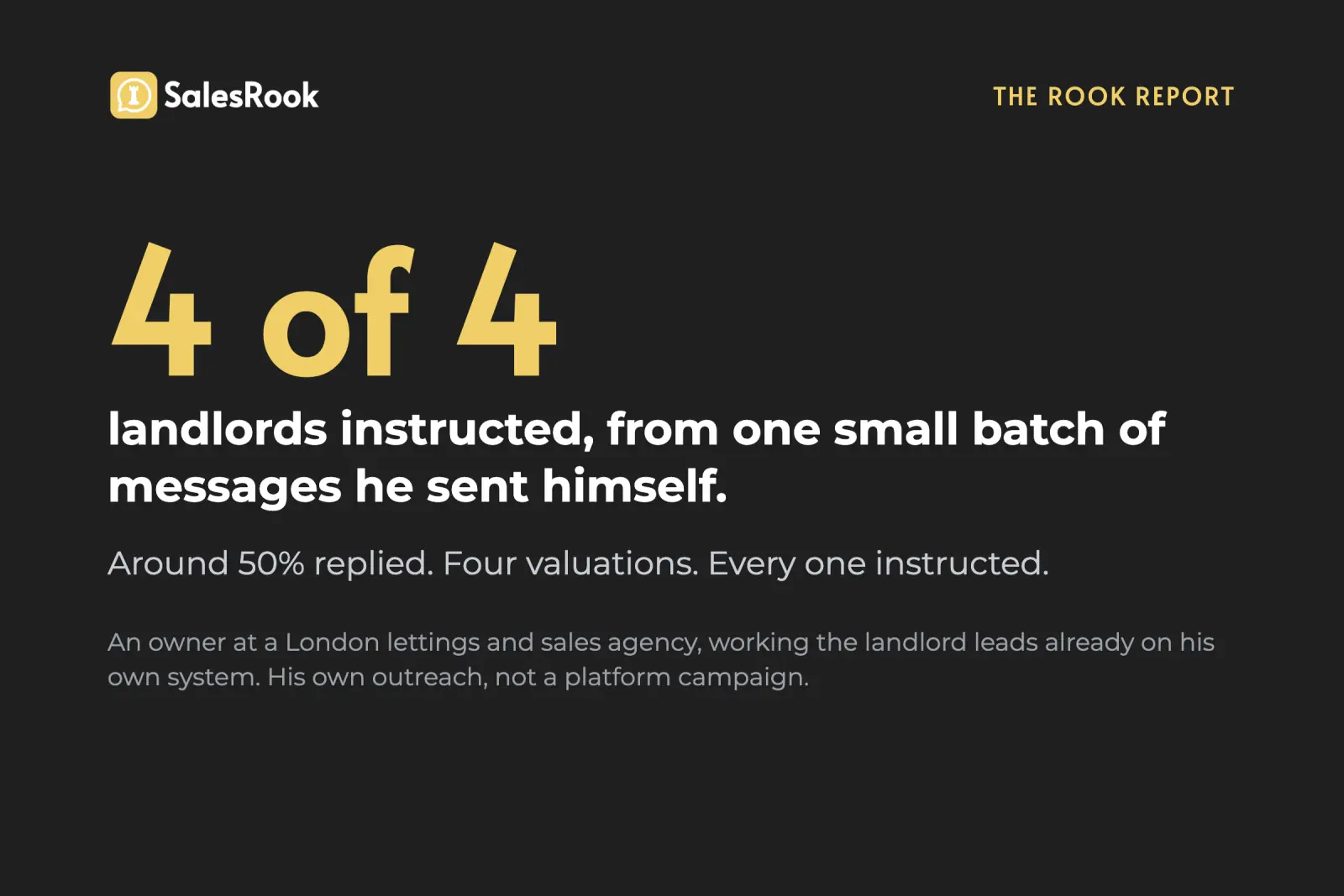
Four instructions, all won, from a handful of the right messages. That is the whole thesis in one anecdote. The landlord will not raise his hand for a leaflet. He is far more likely to reply to a specific, well-timed message that treats him like a person with a decision to make. The difference is not the channel. It is whether there is a conversation on the other end. A broadcast ends the second it lands. A conversation asks a question, listens to the answer, and knows what to do next.
This is not a fringe idea that only vendors talk about. The wider industry is openly chewing on the same problem: how a lettings agency wins more landlords without simply spamming them. This short talk from lettings commentator Christopher Watkin is a good, honest example, worth a few minutes before you plan your next landlord push.
Not a vendor argument: the industry asking its own question, how do you win landlords without shouting at them?
Agents who lean into landlord acquisition this way, conversation first, tend to see it show up in the numbers. One North London director told me his agency reported a 45% jump in new move-ins compared with the same month a year earlier, in a market where supply is meant to be shrinking. That is one director's own reported number, not an audited figure, so treat it as a straw in the wind rather than proof. But it is the direction you would expect when a branch stops broadcasting and starts noticing.
WhatsApp is where that conversation actually happens
We keep coming back to WhatsApp for this because it is where people reply, and it is the same front door we set out in full in our guide to WhatsApp for estate agents. Across the 300,000+ enquiry messages we handle every month, a first WhatsApp message earns a reply from the great majority of the people it reaches, approaching 87% on average. Email is a different universe: getting one opened at all is roughly a one-in-five event, and an actual reply is rarer still. That is our own measured platform performance, not a customer's testimonial, and I will always label it as such. But it is the number that makes this whole model work: if the landlord never replies, none of the rest matters.
And it lands in the evening, when people are actually on their phones. Rightmove's own data shows property search peaks every evening, with the single busiest minute of the week at 8.48pm on a Wednesday. The person finally weighing up whether to let the flat is very likely part of that 9pm crowd, phone in hand, long after your branch has locked up. A WhatsApp conversation is happy to meet him there. A voicemail is not. That gap, between when landlords think and when branches are open, is exactly where the pound goes missing.
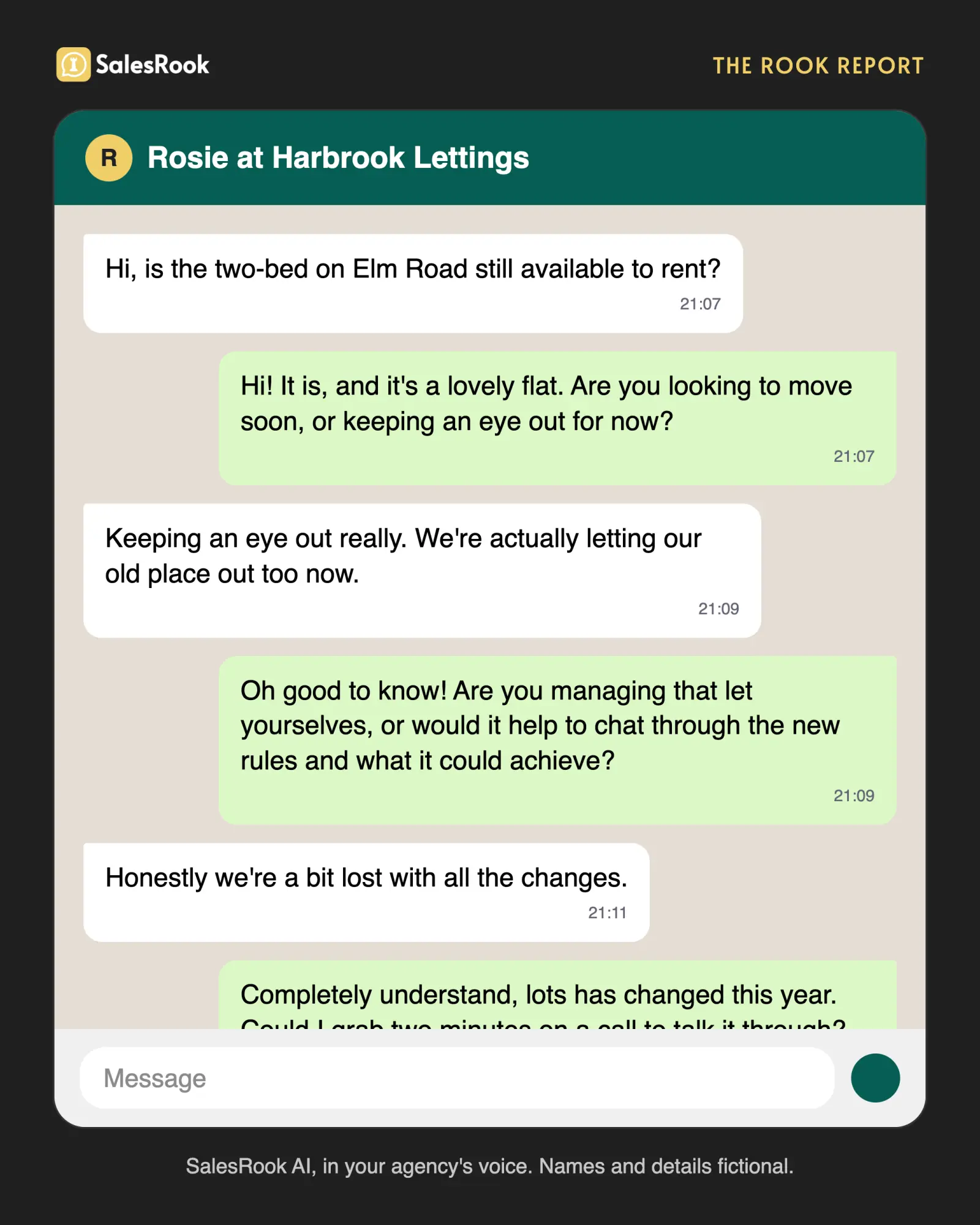
The same enquiry a hundred branches would treat as just another tenant. One light question surfaces a landlord, and offers two minutes instead of a hard sell.
The move that ties it together: ask for two minutes, not a valuation
Here is the small mechanical thing that beats everything else, and it is worth writing on the office wall. Do not ask the landlord for a valuation. Ask him for two minutes.
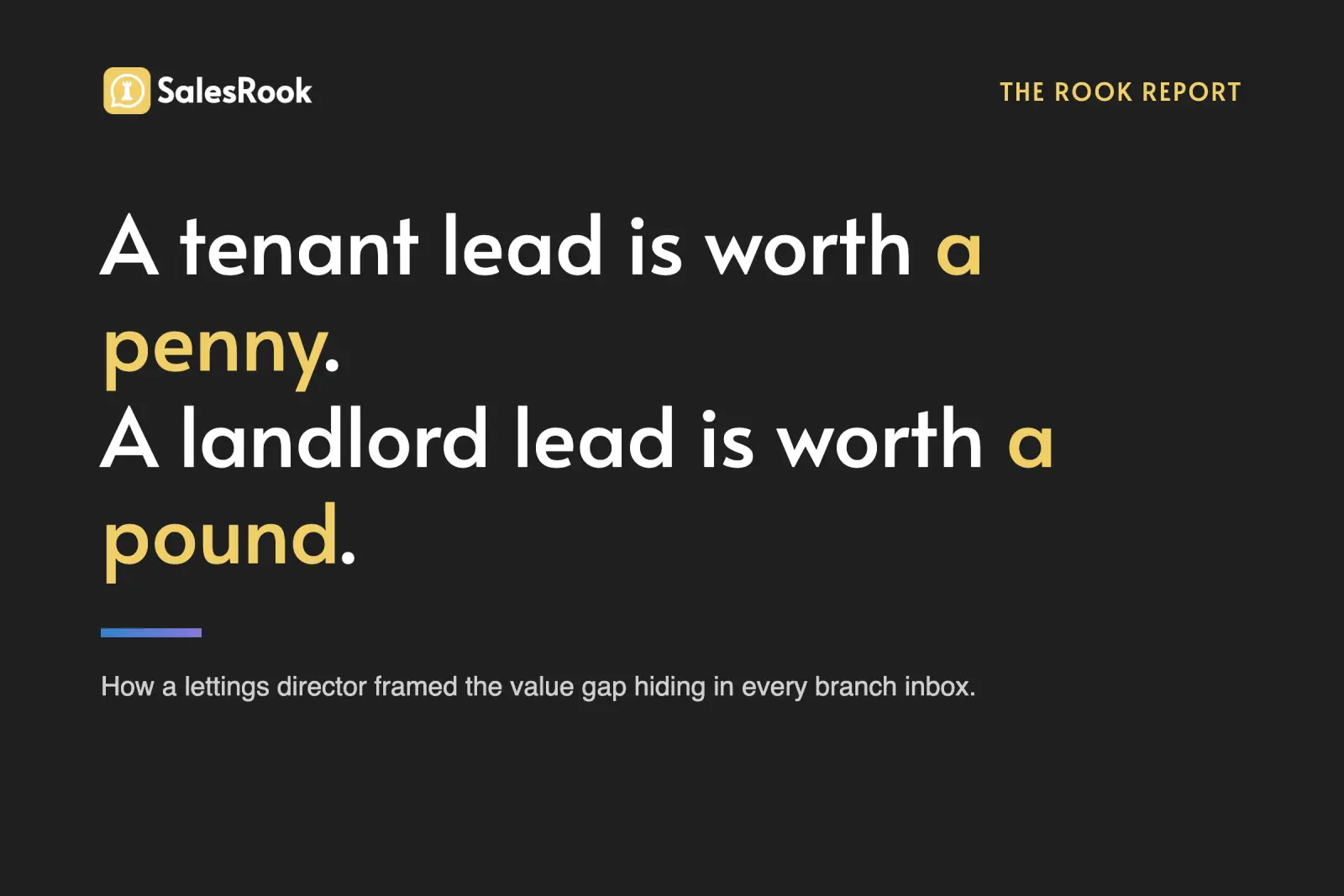
When a conversation spots a possible landlord inside an enquiry, the wrong next step is a hard "shall we book a market appraisal?" A valuation is a big, slightly exposing commitment. As that same agency owner put it to me, it is a little abrupt, because you are asking to walk into someone's home, and everyone is protective about their home. His own conclusion: what really moves the needle is getting them on the phone first. So the right next step is small: a friendly offer of a quick two-minute call to talk through the new rules and what the property could achieve. Low stakes, high relevance, an easy yes.
The valuation comes from the call. The call comes from the two-minute ask. And the two-minute ask only ever happens if something was listening closely enough to notice a landlord in the first place. Get that sequence right and you are not manufacturing landlord leads out of thin air. You are harvesting the ones you were already ignoring.
And because it is 2026, it has to be logged
One more reason to run this through a proper system rather than a staff member's personal phone. Under the Renters' Rights Act regime, how you handle a landlord and a tenant is no longer only a service question. It is increasingly an evidence question. Who said what, when, and did you act inside the timescales the law now sets. The enforcement teeth are real: this is policed by local councils, with civil penalties of up to £7,000 for a first breach and up to £40,000 for serious or repeat ones, not by some distant regulator you will never meet.
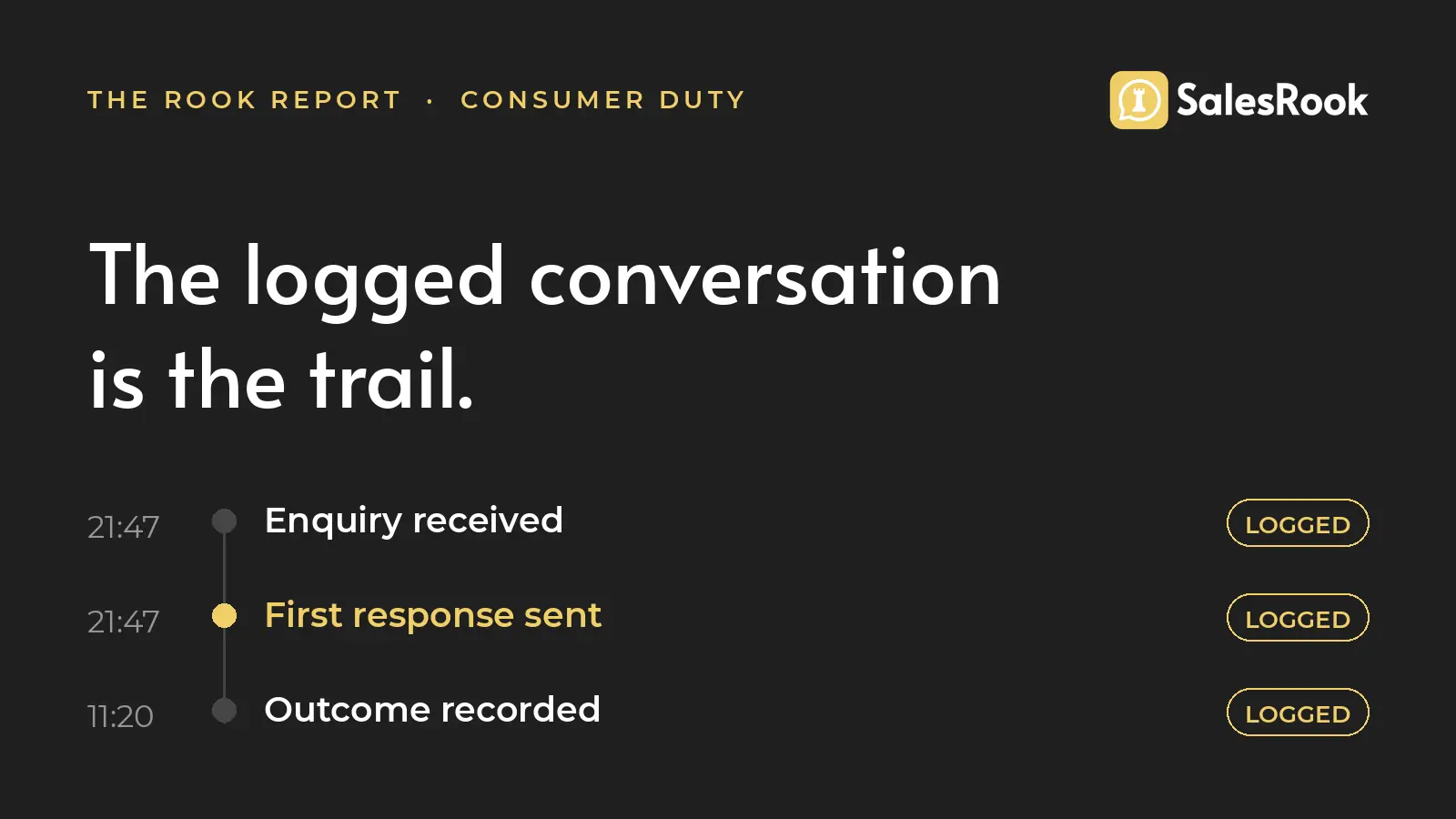
One director put the worry to me exactly right: who is dealing with a message when it comes in, and where is the trail, where are the notes in the system. It is a fair question, and the honest answer for most branches is that the trail lives on someone's phone.
A conversation that is logged, timestamped, retained, and revocable the day a staff member walks out of the door is no longer an IT nicety. It is part of the service you are selling, and it is why the lettings industry's own body, ARLA Propertymark, under president Kim Lidbury, frames clean process as the thing that protects an agency, not the thing that slows it down. The same infrastructure that surfaces the landlord also gives you a cleaner audit trail when someone later asks you to prove how you handled him.
Keep the human where the human matters
I am not suggesting you automate the landlord relationship. That would be the exact opposite of the point, and the whole case for AI for letting agents is that it protects the human moment rather than replacing it. What you automate is only the part before the relationship: the round-the-clock work of noticing which of a thousand ordinary enquiries is quietly worth a pound, and asking the one question that gets it into the room. Your best negotiator, sitting up at 10pm tagging enquiries she will never have time to chase, is wasted on that. Free her for the valuation and the doorstep, and let the system do the noticing.
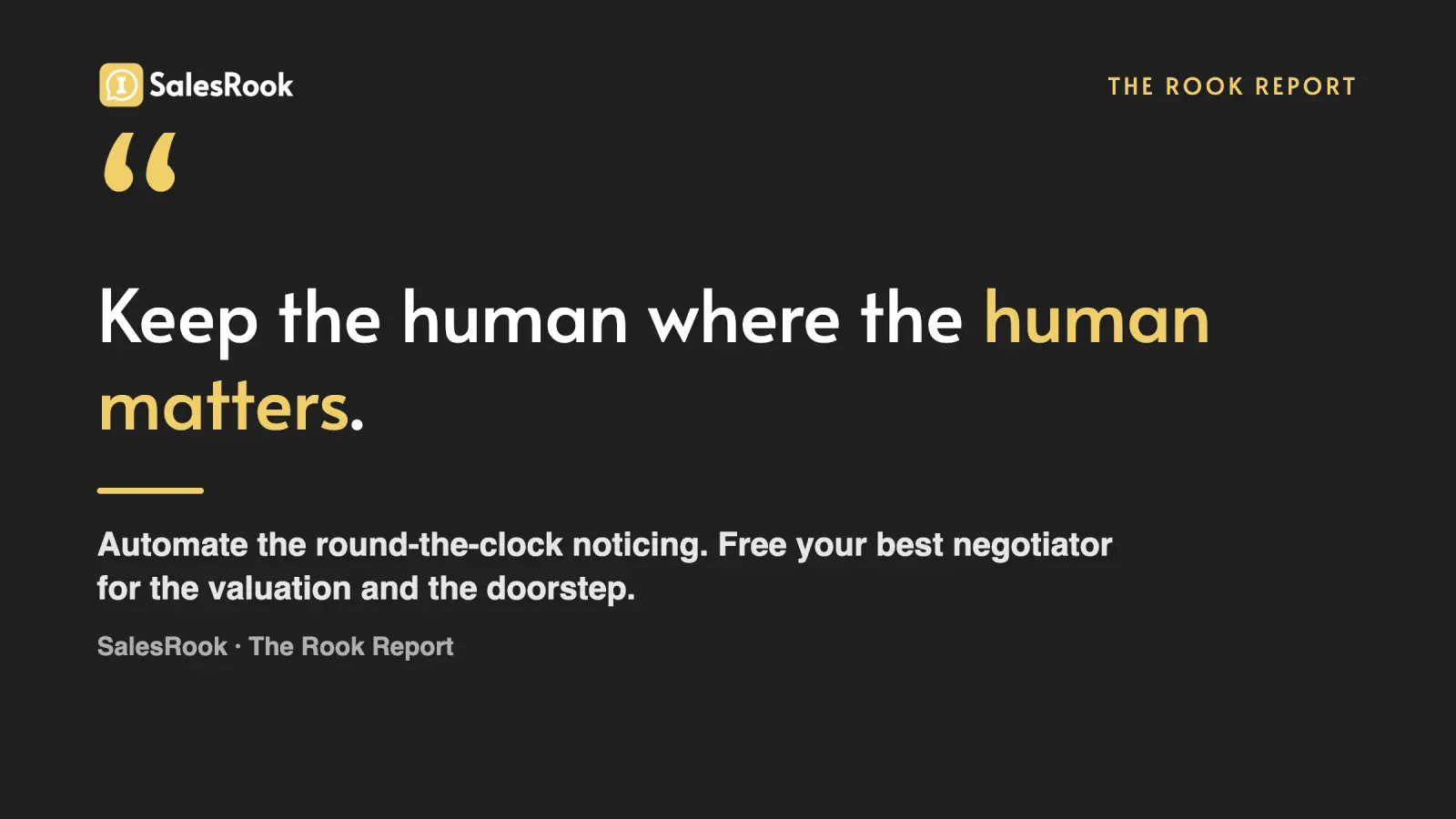
Automate the noticing, never the relationship. The valuation and the doorstep stay firmly with your people.
How to surface the landlords you are already ignoring
I would rather teach you to run this properly, with any tool you like, and if you are shortlisting one, our comparison of the best WhatsApp AI tools for UK estate agents runs the same rule over the market. Here is the checklist we would apply to turn your existing enquiry flow into a landlord pipeline, and you can hold any provider to it:
- Ask the one question on every enquiry. A light, natural "do you let a property yourself, or are you thinking about it?" woven into the flow. The value is entirely in the word every, day and night, not just the ones your team reaches by five o'clock.
- Answer out of hours, or do not bother. Prospects are active at 9pm. If your process only works between nine and five, you have designed it to miss exactly the people worth the most.
- Ban the cold blast as your opener. A broadcast can warm a list you already talk to, but it will not manufacture landlords from strangers. Lead with a conversation, not a shout.
- Ask for two minutes, not a valuation. Offer the low-stakes call first. The appraisal is what the call is for, it is not the thing you open with.
- Keep the human for the human part. Automate the noticing and the first light question, then hand a warm, qualified landlord to a real person for the relationship. Never the other way round.
- Log everything by default. Timestamped, retained, owned by the agency and not by a staff member's phone. In the Renters' Rights Act era, the audit trail is part of the product.
If a landlord instruction is genuinely worth a hundred times a tenant one, then surfacing even a handful of extra landlords a month from enquiries you have already paid the portals to send you, the leads you already pay for, is not a marginal gain. It is very possibly the cheapest revenue line you will add all year, because you are not buying new leads at all. You are finally reading the ones you already have.
Since 1 May, doing nothing quietly costs more than it used to. The renewal fee that used to cushion a slow quarter has gone, and the landlords who could replace it are messaging your branch right now, indistinguishable from the tenants, waiting for someone to notice. A tenant lead is worth a penny. A landlord lead is worth a pound. They are arriving in the same inbox, at the same time, on the same channel. The only question that matters is whether you have anything in place that can tell them apart before the pound gets bored and puts the phone down.
If your branch is fielding landlord enquiries that never quite get asked the right question, that is exactly the gap worth closing. Send us last month's enquiries and we will tell you how many landlords were hiding in them.

Max Hardy
Co-Founder
Max Hardy is the Co-Founder of SalesRook, a leading provider of AI solutions for the property sector. With a background in technology and property, Max leads SalesRook's mission to transform how estate agents and mortgage brokers engage with leads through AI-powered WhatsApp automation.