
I have spent this year watching an argument the industry was still politely having get settled for it. In February 2026, Rightmove, the portal every one of these agents already pays, launched a beta of its own AI-powered conversational property search, built with Google Cloud, that lets a buyer describe the home they want in plain words and have a machine answer back. When the biggest name in UK property puts an AI on the front of the search itself, the question stops being whether an AI will greet your buyer. It already does.
So the only decision left to you is whose AI it is, and whether the one carrying your name sounds like your best negotiator or like a machine. Because here is what has actually happened while everyone debated the principle: your buyers and sellers have already voted on which channel they want to talk to you on. They chose WhatsApp, and the vote was not close. Your negotiators followed them there, because good agents follow the customer, but they did it on personal phones, with no record, no oversight, and no way to get the relationship back when someone leaves. The channel is right. The infrastructure is missing.
This piece is the argument I make to directors who ask me why WhatsApp, why an AI on the front of it, and why now. I run SalesRook, which now handles more than 300,000 property enquiry messages a month, so I am not neutral, and I will not pretend to be. But the figures below are real, and where a number is our own product data rather than an independent result, I say so plainly.
What "WhatsApp for estate agents" actually means
At its simplest, it is moving your first response to a lead off email and onto WhatsApp, and putting an AI on the front of it so no enquiry ever waits.
A buyer sees your listing on Rightmove or Zoopla at 9pm, sends an enquiry, and instead of dropping into an inbox nobody opens until morning, they get a friendly WhatsApp reply in seconds. The AI asks the questions your best negotiator would ask. Are you a cash buyer, or do you need a mortgage. Do you have a property to sell. What is your timeline. By the time one of your people picks it up, the lead is qualified, the context is captured, and the conversation is already warm.
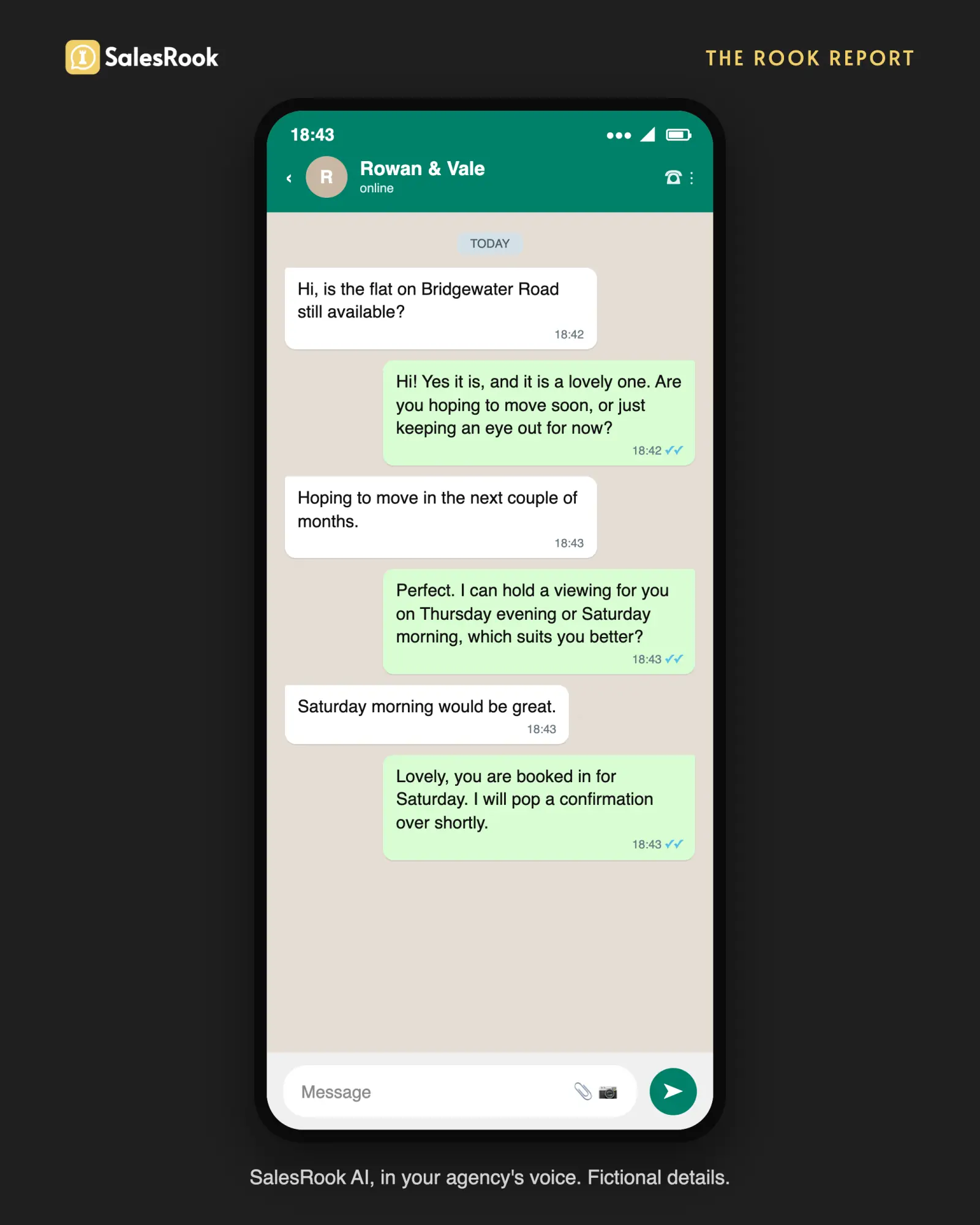
The front door in practice: an enquiry at 18:42, a warm reply in seconds, a viewing offered for Thursday or Saturday before a human has touched it. Illustrative example.
That is the whole idea. Answer instantly, on the channel people actually use, and never let a negotiator start a call cold again. It is the highest-leverage change most agencies can make to their front door, because it fixes the two things that quietly lose you business every day: how fast you respond, and on which channel.
And agents are already moving. Alto's 2026 Agency Trends Report found that 52% of agents plan to adopt AI tools within the year, though around a third describe themselves as nervous or unsure, and that hesitation is heaviest among exactly the independent, relationship-led firms this piece is written for. The question was never whether it works. It was always whether it will embarrass you. I will come back to that, because it is the real objection.
Why WhatsApp, and not email or web chat?
Because WhatsApp is where people reply. Everything else in this argument is downstream of that one fact.
It is not a hunch. Ofcom's 2025 Online Nation report puts WhatsApp in the hands of around 90% of UK adults, one of the most-used messaging apps in the country. Your customers already have it open, because it is where the family group chat lives. Notifications get seen. A cold or semi-cold email, by contrast, is lucky to be opened by one in five. When your front door is an email autoresponder, you are answering on the one channel your customer is least likely to read.
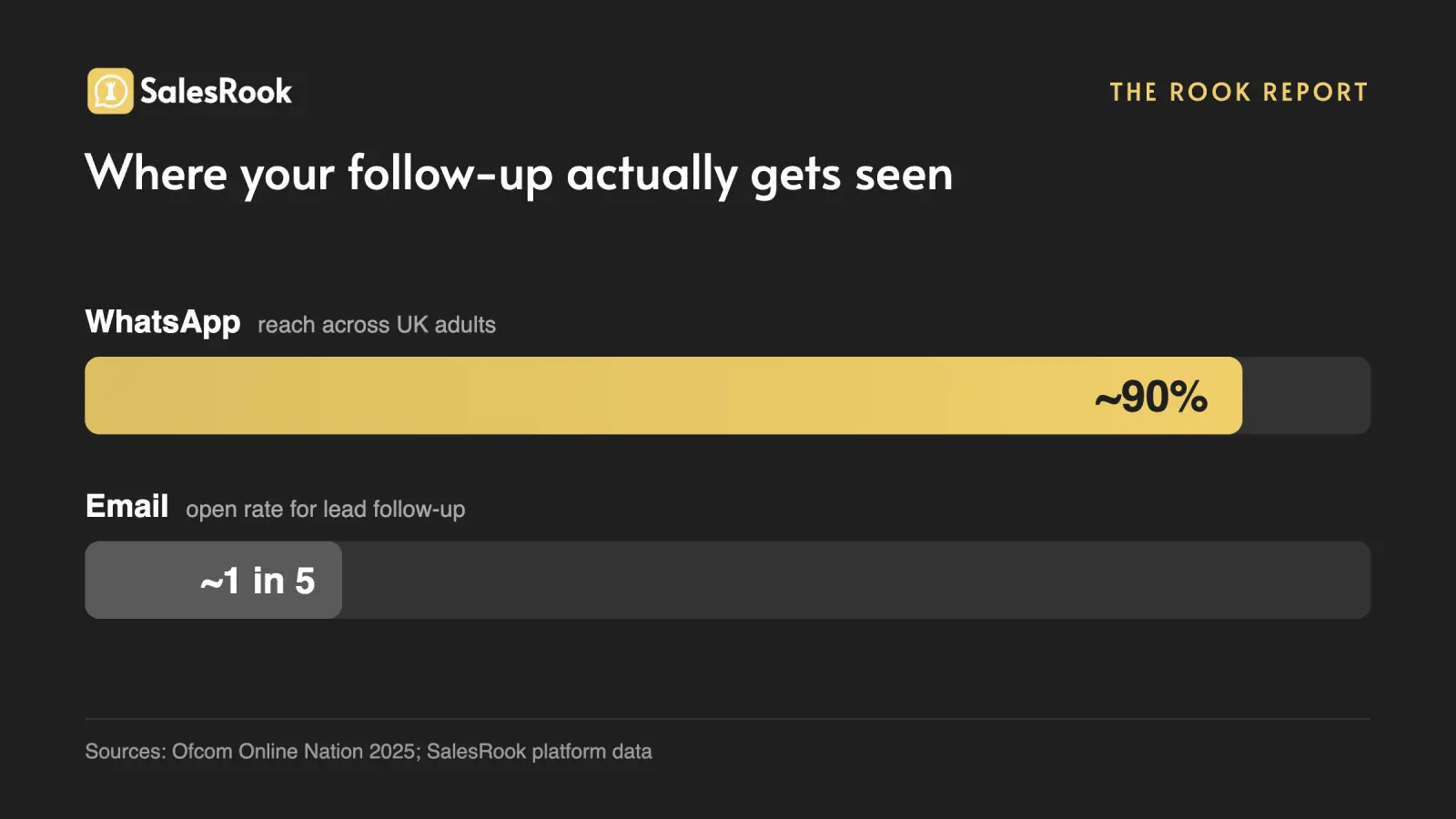
Reach versus open rates: WhatsApp reaches around 90% of UK adults, while lead-follow-up email is lucky to be opened by one in five. Sources: Ofcom Online Nation 2025 and SalesRook platform data.
In our own enquiry conversations we see reply rates approaching 87%, on open rates of 98%. I want to be precise about what those numbers are: they are SalesRook product claims, measured across our own client cohort, not a single agency's audited result. But the direction is not controversial. When the medium is the one people actually check, the reply rate follows.
Around 90% of UK adults use WhatsApp
one of the most-used messaging apps in the country (Ofcom, Online Nation 2025). It is the one channel you can be almost certain your customer will see.
There is a second reason, and it is about how the conversation feels. WhatsApp is informal, it threads, it keeps history. A buyer can pick the chat back up three days later and everything is still there. That continuity is very hard to reproduce over email, and impossible over a web-chat box that vanished the moment they closed the tab.
And this is not fringe behaviour any more. Choices, a South East England lettings and estate agency, runs an AI chatbot over WhatsApp for enquiries and appointment scheduling. The channel has already crossed from consumer habit into how agencies actually operate. The interesting question now is what you put on the front of it.
What does the AI actually do?
This is where WhatsApp for estate agents becomes AI for estate agents. The channel gets people to reply. The AI is what makes replying at scale possible, and it is the layer that qualifies every single enquiry rather than just acknowledging it.
Here is what it handles, out of the box:
- Instant first contact. A first reply in around 20 seconds, day or night, to every enquiry (SalesRook internal platform data).
- Real qualification. It asks the questions that matter and listens to the answers, rather than firing off a canned form.
- Opportunity spotting. It notices when a buyer also has a property to sell, or needs a mortgage, and flags it.
- A clean handoff. Your negotiator opens the CRM to a rich summary of the whole conversation, not a name and a phone number.
That last point is the one directors tell me changes their mornings. Instead of a negotiator ringing a lead and grinding through the basics, they start already knowing this person is a first-time buyer, mortgage not yet arranged, looking in a two-mile radius, needs to move before September. They skip straight to the useful conversation.
The AI does the admin and the after-hours. The human does the relationship. That division of labour is the whole product philosophy, and, as we will see, it is the one the industry's own leadership endorses.
How fast does it respond, and why does speed matter so much?
Speed to lead is the least disputed fact in this entire market, and it is worth being specific about how big the effect is.
The classic evidence is the Harvard Business Review lead-response audit, a US study of thousands of companies, which found that firms reaching a lead within the first hour were nearly seven times more likely to qualify it than those who waited even an hour longer, and more than 60 times more likely than those who left it a day. It is a US, cross-industry finding rather than a UK property figure, but the shape of it holds everywhere: lead value decays fast, and the first minutes are worth more than the next hour.
The expectation has caught up too. Street Group's July 2026 survey of 1,830 recent home sellers found that 85% expect a response to a selling enquiry within 24 hours. Twenty-four hours is now the floor, not the target, and the seller who does not hear back simply messages the next agent on the list.
Now layer on when enquiries actually arrive. Across our platform, roughly half of all qualified enquiries land outside business hours, many of them in the evening once people are home and scrolling the portals (SalesRook internal platform data). That is exactly the traffic a nine-to-five inbox sleeps through, and every one of those messages is a lead you have already paid a portal to generate.
You are already paying for these leads. The failure is almost never supply. It is response.
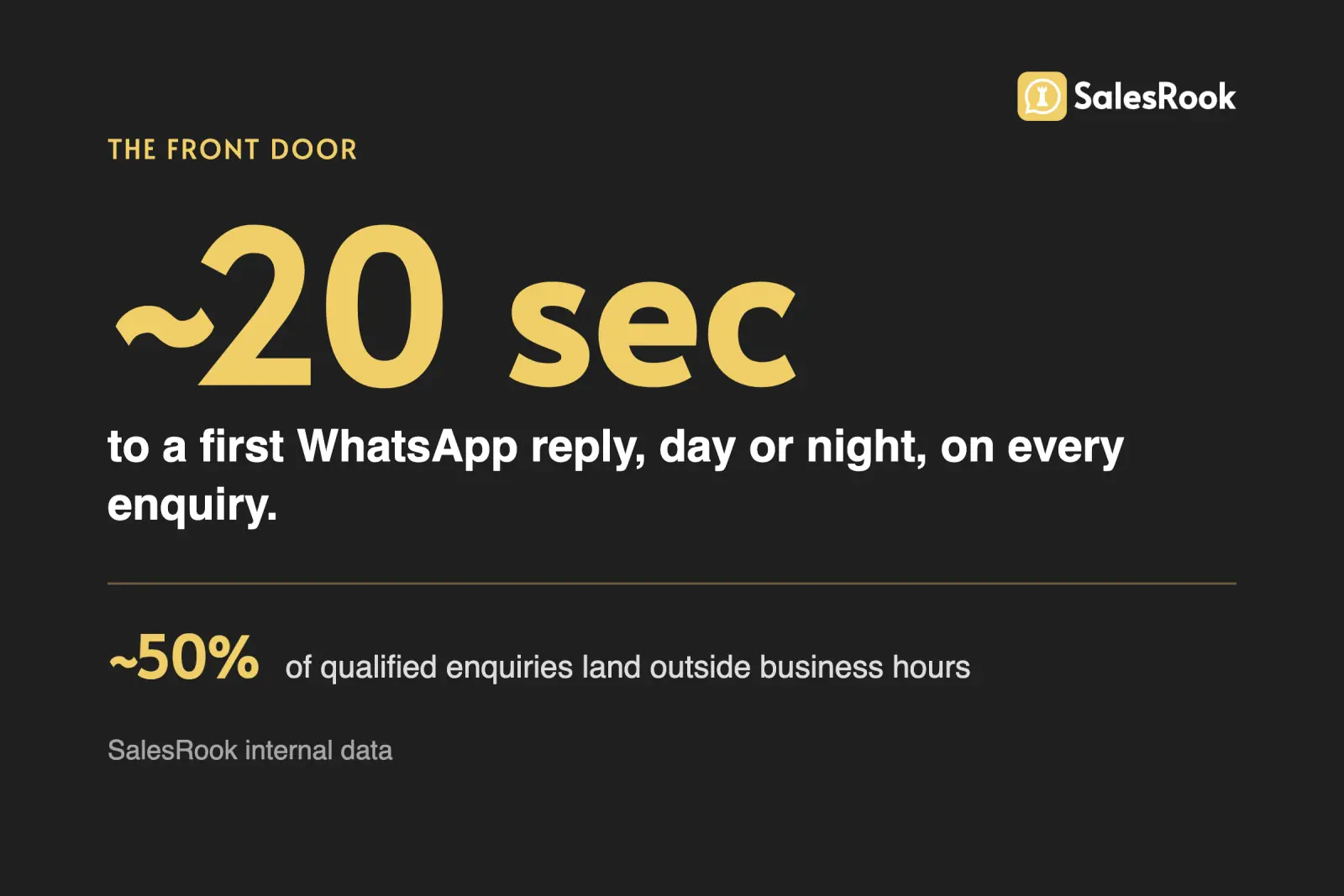
The speed-to-lead maths is the beating heart of the whole case, and we treat it as its own discipline. For the full playbook on converting the enquiries you already pay for, see our guide to estate agent lead generation.
Will it sound like a robot?
This is the real objection. Not "does AI work," but "will it embarrass my brand." It is why agents try AI once, get generic output, and never touch it again. And it is a fair fear, because whatever answers first is, in the words of one director I spoke to, "people's first impression of our company."
So let me answer it honestly. Yes, a badly set-up AI sounds like a bot, and that does more harm than a slow reply. The tells are specific and fixable: the compliance furniture ("reply STOP to opt out"), the interrogation that fires sensitive questions before any human would, the rigid script that ignores what the person just said. None of those are AI problems. They are configuration problems.
The mechanism matters here. Rather than firing templates down a decision tree, a good system writes every message from scratch, in context, so it reads like a person thinking rather than a workflow executing. Two things move the needle in our data: a warm, named persona rather than a faceless "assistant", and being honest about the AI when asked, which costs around 4 to 5% of responses, a price we pay gladly for the trust and the compliance clarity.
You do not have to take my word for it that this is the live debate. This Kyero panel of proptech and agency voices is having exactly this argument: do buyers still want the human touch now AI sits at the front of the property conversation? It is worth twenty minutes of any sceptic's time.
The industry is already asking this out loud, not just SalesRook. Adoption without warmth is the risk, not AI itself.
The test I hold us to is simple. If a buyer cannot tell whether they are annoyed at a bot or grateful to a helpful person, and they keep replying, the tone is right. If they can tell and they bristle, it is wrong, and no amount of speed fixes that. For the deeper dive on how tone is trained, see our guide on whether an AI chatbot has to sound robotic.
Is WhatsApp compliant for estate agents?
Short answer: WhatsApp done properly is more compliant than what most agencies do today, not less. Done improperly it is a real risk. The whole difference is business infrastructure versus personal phones.
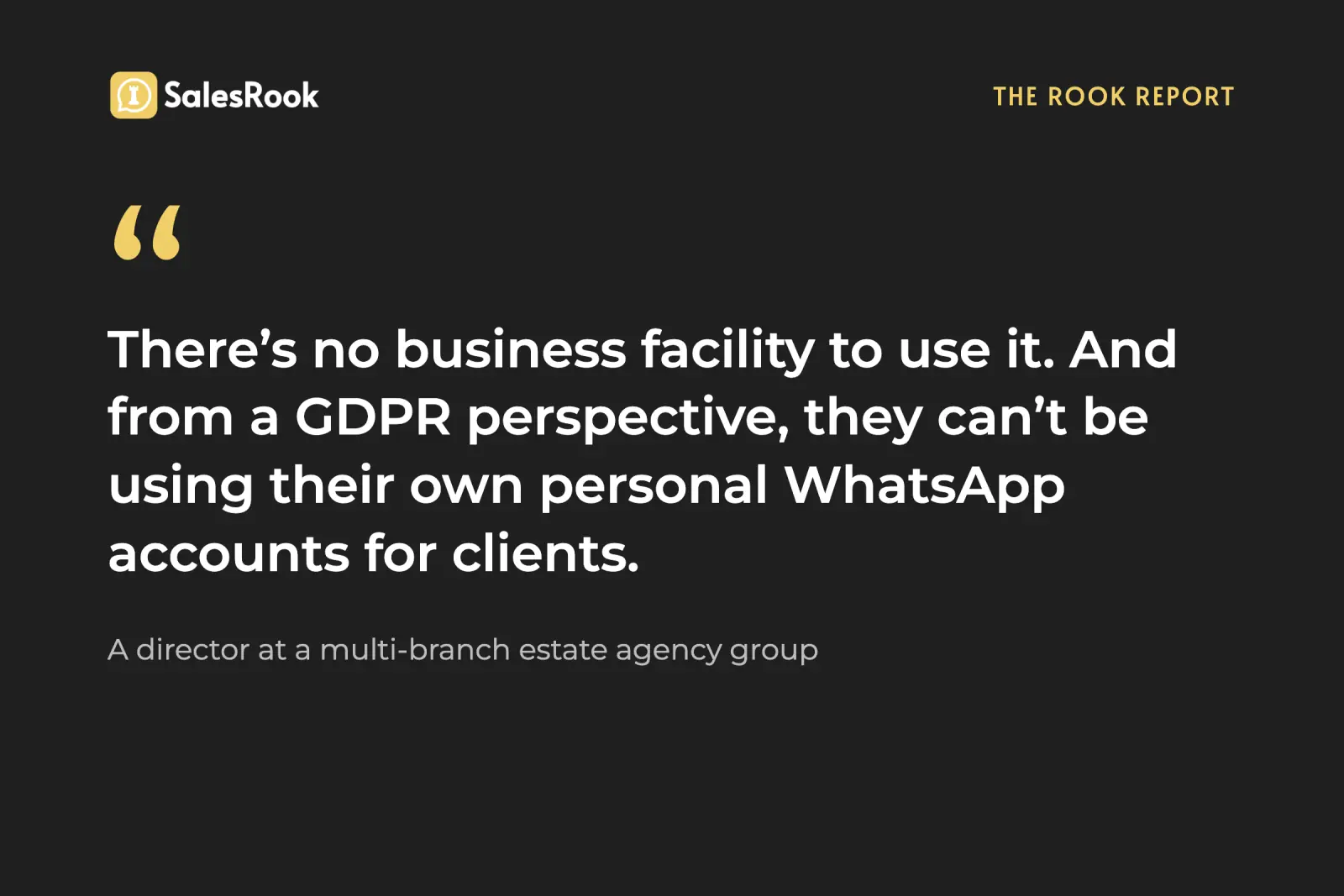
Here is the problem I see constantly. Negotiators, quite reasonably, message clients on their own personal WhatsApp because it is fast and it works. But there is no business facility behind it. A director of a large multi-branch agency group set out his firm's position on that squarely:
"There's no business facility to use it. And from a GDPR perspective, they can't be using their own personal WhatsApp accounts for clients."
A director at a multi-branch estate agency group
He was clear that he did not believe his own negotiators were doing it at any scale, and that his firm had made them aware of the GDPR position. That is the responsible answer, and it is also the point: the rule only holds where someone has actually set it. Where nobody has, client conversations end up sitting on a staff member's personal account with no oversight, no audit trail, and no way to recover them when that person leaves. As another director put it to me, the worry is simple:
"who's dealing with that message when the message comes in… where's the trail, where's the notes in the system"
A director at a London estate agency
A proper WhatsApp-AI setup answers every one of those questions:
- Every message is logged, timestamped and retained against the record, not on a personal phone.
- Access is revocable. When someone leaves, you switch them off. The client relationship stays with the business.
- The audit trail is automatic, which matters more every month.
That last point is not abstract any more. The Renters' Rights Act 2025, which received Royal Assent on 27 October 2025 with its main provisions coming into force from 1 May 2026, makes response-logging and timescale tracking a practical expectation for lettings. Crucially, it is enforced by local councils through civil penalties, up to £7,000 for a breach and up to £40,000 for offences, not by the Information Commissioner's Office.
Data protection is a separate risk again. The ICO governs how you handle personal data under GDPR, and that is precisely where the personal-phone habit exposes you. A business WhatsApp channel is not the compliance problem. It is the compliance fix for a habit your team already has.
Does it replace my negotiators?
No, and I would not sell it to you if it did. The point is to move your best people off admin and after-hours cover and onto the parts of the job only a human can do. And I am not just saying that because it sells better. It is the honest objection my own customers raise, and the consensus view of the industry's own leadership.
A negotiator at one of our own customers was blunt with me about the limits, and she was right. Her point was that the product earns its keep when you are not in the office and cannot get through your leads. When you do have the manpower to call them yourself, the first contact is better coming from a real person who knows the property and can build the urgency there and then.
Her firm nearly switched the AI off over exactly that, and we did not argue. We salvaged it not with a rebuttal but with a configuration change: a human-plus-AI hybrid, where during office hours a free negotiator takes the lead, and out of hours, at the weekend, and during the overflow that breaks every busy branch, the AI is the always-on safety net that means no enquiry sits unanswered until Monday. The answer to "it feels impersonal" was never to switch the AI off. It was to give the agent control over when it speaks.
The industry's leadership lands in the same place. Propertymark chief executive Nathan Emerson has put it plainly: buying or selling a home is still an incredibly personal process, and AI's job is to free agent capacity, not to stand in for the human. As ARLA Propertymark's president framed it in early 2026, the agencies that thrive will be those using AI to enhance their services, not replace the human element. Kim Lidbury, ARLA Propertymark's current president, leads a body whose whole message to members is that the relationship is the product.
Even the data from the most AI-forward market agrees. In the US, where buyers lean hardest on AI to research a purchase, 81% of buyers still consider a human agent essential to the deal (AceableAgent's 2026 US survey, reported by Forbes; a US market, but the signal travels). So the model is augmentation. Your negotiator walks in to warmer leads and better information, and spends the day being a deal architect instead of a data-entry clerk.
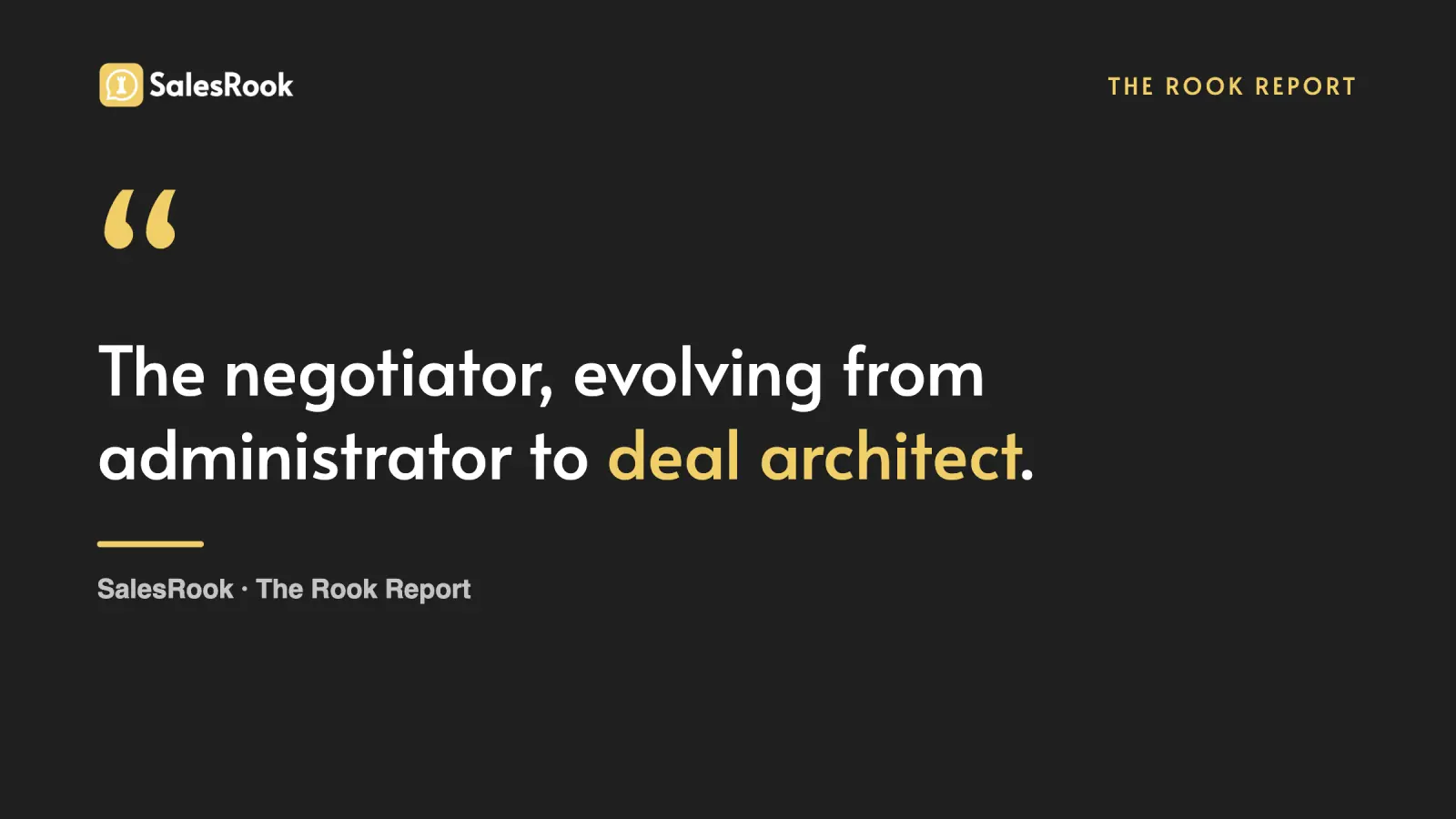
Forget AI replacing agents. What is actually happening is the negotiator evolving from administrator to deal architect.
Does it work with my CRM?
For most agencies, yes. SalesRook is built integration-first: every WhatsApp conversation is designed to sync into your existing systems rather than become another silo to check.
We integrate live with Reapit, LeadPro, Homeflow, Alto, AcquaintCRM, Street, AgentPro, Rex CRM, Loop CRM, the Mortgage Advice Bureau Platform and Mortgage Kart, plus the wider mainstream market through Zapier, which effectively means Salesforce, HubSpot and just about anything else your office already runs on.
I would rather be careful here than over-promise, because this is where a lot of tools quietly let agents down. Integrations vary, and some create-only APIs spawn duplicate records if they are not set up correctly. We handle that by pushing qualified, de-duplicated leads in and switching off the native feeds that would otherwise double them up. It is solvable, but put the question to any vendor directly, us included.
What results do agencies actually see?
Here I will give you real, aggregate patterns and one named, public example, rather than a string of numbers you cannot check.
Across the agencies we work with, the pattern is consistent: replies in seconds rather than hours, reply rates approaching 87% (our product claim, cohort-measured, not any single client's audited figure), and around one in five buyer enquiries hiding a valuation opportunity the agency would otherwise have missed, because the buyer also has a property to sell.

The 9pm enquiry a nine-to-five inbox never sees. On WhatsApp, it gets answered before she has put the phone down.
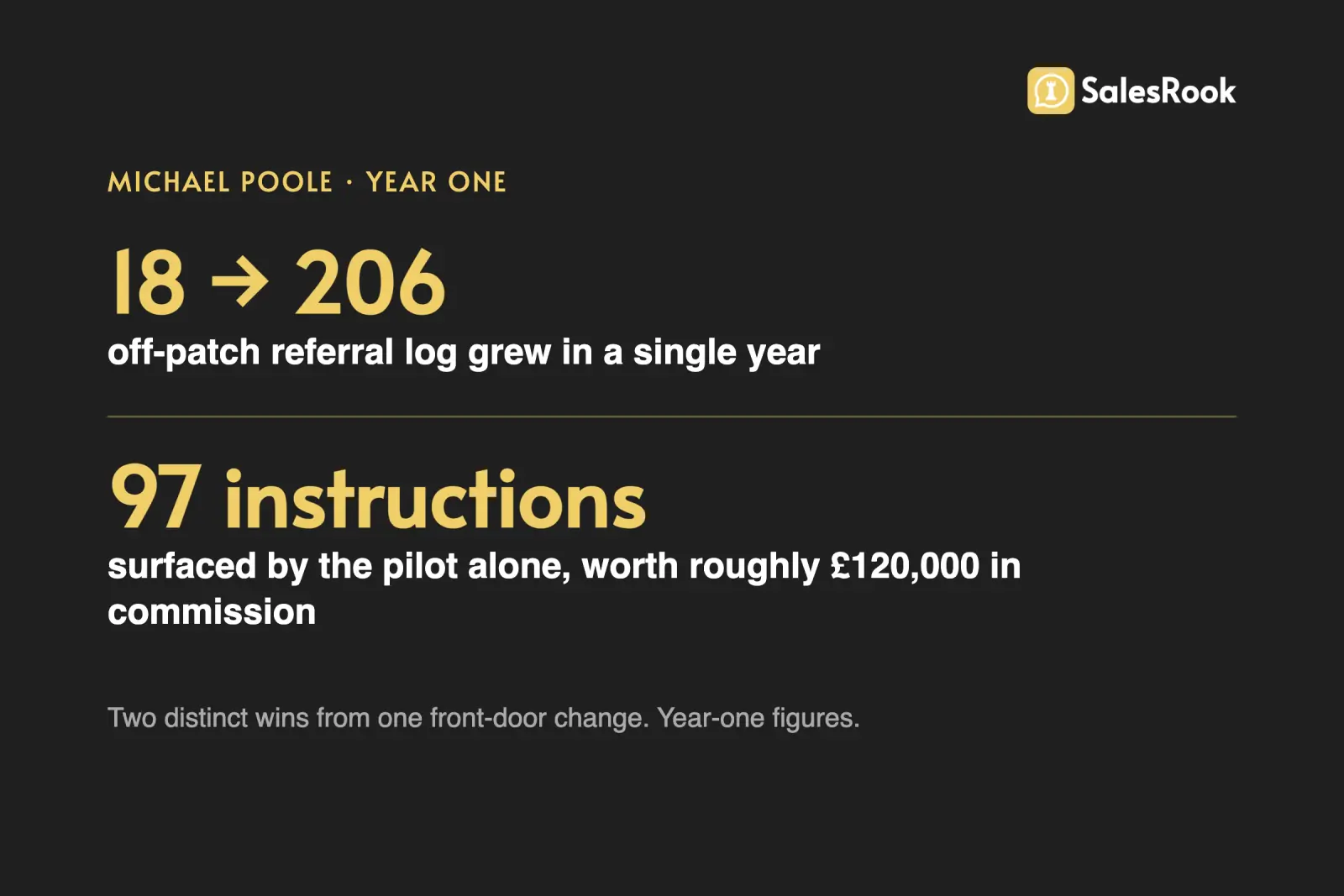
The clearest public example is Michael Poole, the North-East agency. In year one, Michael Poole grew their off-patch referral log from 18 to 206, feeding valuations outside their own area to the Relocation Agent Network. Separately, and this is a distinct win, their pilot alone surfaced 97 instructions worth roughly £120,000 in commission, while saving the equivalent of more than two full-time people in enquiry-handling time. I keep those two results deliberately separate, because they came from different parts of the same front-door change and it would be dishonest to imply one produced the other.
And when the scepticism breaks, the reactions are not lukewarm. A lettings owner who tried one warm message to his landlords won four valuations from it, a story we tell in full in our piece on why a tenant lead is worth a penny and a landlord lead is worth a pound. A branch principal, watching it work, said, "I'll have to leave you a Google review." Nobody talks about a robot that way.
How is this different from a chatbot, a call centre, or a voice bot?
Fair question, because a lot of things get lumped together as AI for estate agents. Here is how I would separate them.
| Channel | The catch | Where WhatsApp-AI wins |
|---|---|---|
| Website chatbot | Only works while someone is on your site; usually dead-ends into a form. | Follows the buyer into a channel they check all day and keeps the thread alive for days. |
| Human call centre or web-chat team | Real people, which is lovely, but it does not scale on cost and still is not instant at 11pm. | Always on, every enquiry, at a fraction of the per-lead cost. |
| Voice bot answering the phone | The thing consumers tell us feels most "scary" and most obviously automated. | Text on WhatsApp is calmer, less pressured, and far easier to get the tone right. We have made the full argument for text over voice separately. |
And the way I would judge any of them is not by features. It is by cost per outcome. Not cost per seat, not cost per message. What does one qualified appointment, one recovered valuation, one mortgage referral actually cost you through this channel, versus what you pay a portal for the same result?
The instinct behind that question is simple: ten enquiries that turn into two instructions beat a hundred that turn into one, because the hundred also cost your negotiators a week of calls to discover that ninety-eight of them were never moving. On a cost-per-outcome measure, WhatsApp-AI tends to win comfortably, because it extracts more from leads you have already paid for.
Where WhatsApp fits in your funnel
One last framing, because agents ask where this sits. WhatsApp-AI is your front door. It does not replace your portal spend, your CRM, or your people. It sits in front of all of them and makes sure every pound you already spend generating an enquiry actually converts into a conversation.
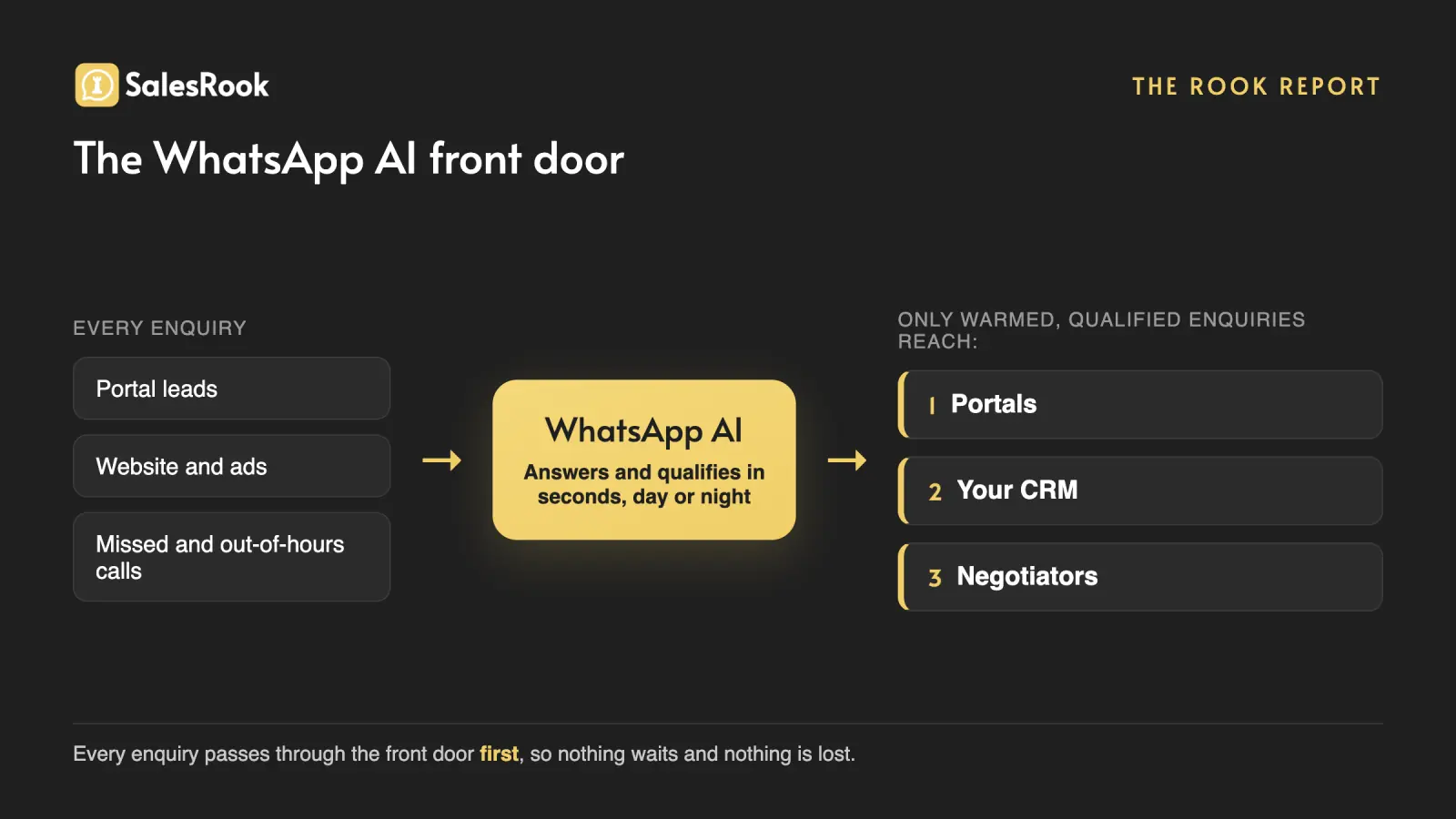
This is not a fringe bet, either. The portals are moving the same way: Rightmove has built its own beta AI conversational search with Google Cloud. AI is arriving at the front of the property conversation whether or not you choose it. The only question is whether the AI carrying your name sounds like you.
You keep Rightmove. You keep Street or Reapit or Alto. You keep your negotiators. You just stop losing the 9pm enquiries your inbox cannot answer to the agent down the road who replied first. For how the same model runs across sales and lettings, WhatsApp for real estate agents follows the identical logic: answer instantly, on the channel they chose, whether the enquiry is a buyer or a tenant.
How to get this right, with any tool
I would rather teach you to get this right than sell you a mystery. If you are putting WhatsApp and AI anywhere near your enquiries, here is the checklist we would apply, and you can hold any vendor, including us, to every line of it:
- Put the channel where the customer already is. WhatsApp, not a web-chat box they close, not an email they never open.
- Answer in seconds, not hours. The first minutes carry most of the value; measure your real median response time and be honest about it.
- Give the AI a name and a warm voice. A faceless "assistant" reading a script is the tell that repels people. Write in the voice of the business above the door.
- Warm the conversation before you qualify. Earn the right to ask about budget and position. A human would. So should the AI.
- Insist on a business facility, not a personal phone. Logged, timestamped, retained against the record, and revocable when staff leave. This is compliance and continuity in one.
- Demand a hybrid mode. Your people take over instantly in office hours; the AI covers the after-hours and the overflow. Control, not just automation.
- Judge it on cost per outcome. Per appointment, per recovered valuation, per referral, against your portal spend, never per seat.
Do those seven things and it almost does not matter whose logo is on the software. If you are weighing vendors side by side, our rundown of the best WhatsApp AI tools for UK estate agents applies exactly this checklist to the market. The opportunity is not a product. It is answering the customer, fast, on the channel they chose, in a voice that sounds like you, and keeping the record straight while you do it.
The director I quoted earlier was not wrong to worry. Client conversations scattered across personal phones, with no trail and no way home, really is a problem. But the fix was never to drag everyone back to email. It was to give the channel they already chose the business infrastructure it always lacked. Because an AI is going to answer your buyer at 9pm one way or another. The only decision left is whose it is, and whether the one carrying your name sounds like your best negotiator or like a machine.
You are almost certainly generating enough enquiries already. The opportunity is in the ones going unanswered after 6pm. If you want to see what an instant WhatsApp front door would do to your conversion, give us a week of your enquiries and we will show you, on your own numbers. No pitch. Just your data.
Frequently asked questions
Is WhatsApp allowed for estate agent client communication?
Yes, using a proper business setup. The risk is not WhatsApp itself, it is negotiators using personal accounts with no audit trail. A business WhatsApp-AI setup logs, timestamps and retains every message against the record, and lets you revoke access when staff leave, which is more compliant than the personal-phone habit it replaces.
What is the difference between WhatsApp for estate agents and a normal chatbot?
A chatbot lives on your website and stops when the visitor leaves. WhatsApp for estate agents moves the conversation into a channel buyers check all day, keeps the full history, and uses AI to qualify the lead and hand a briefed summary to a human negotiator.
How quickly does the AI respond to a property enquiry?
In around 20 seconds, at any time of day or night (SalesRook internal data). That speed matters because lead value decays fast, and when a prospect is messaging several agents at once, the one who responds first is usually the one who wins the conversation.
Will buyers know they are talking to an AI, and does it matter?
You can and should disclose it when asked. In our data, being upfront that the conversation is AI-assisted reduces response by only around 4 to 5%, and the trust and compliance clarity are worth far more than that small cost.
Does WhatsApp AI replace estate agents or negotiators?
No. It handles instant response, after-hours cover and qualification, then hands the warmed-up, briefed lead to a human. The industry's own leadership, from Propertymark's chief executive to ARLA Propertymark's president, frames AI as enhancing service, not replacing the human relationship.
Does it integrate with my CRM like Street, Reapit or Alto?
It is built to. SalesRook integrates live with Reapit, Alto, Street, Homeflow, AgentPro, Rex CRM, Loop CRM and more, plus the wider market through Zapier. Qualified conversations sync into your existing CRM rather than becoming a separate silo. Integration behaviour varies by CRM, so it is worth confirming the specifics for your exact setup.
How much does WhatsApp AI for estate agents cost?
The right way to judge it is cost per outcome, not a seat price: what one qualified appointment or recovered valuation costs through this channel versus what a portal charges you for the same result. Pricing depends on your volume and setup, which is what a strategy session covers.
Max Hardy is Co-Founder of SalesRook, the AI-powered WhatsApp platform that helps 1,500+ UK property professionals respond to every enquiry in seconds, across 250+ estate agency offices handling 300,000+ property enquiry messages a month.

Max Hardy
Co-Founder
Max Hardy is the Co-Founder of SalesRook, a leading provider of AI solutions for the property sector. With a background in technology and property, Max leads SalesRook's mission to transform how estate agents and mortgage brokers engage with leads through AI-powered WhatsApp automation.