A few months ago I sat across from a partner at an independent estate agency, the kind of firm where the founder's name is still above the door and half the town has their mobile number. He had been trialling AI on his enquiries, and something about it was gnawing at him. Over the course of that conversation he put his finger on it, and I have not been able to get it out of my head since.
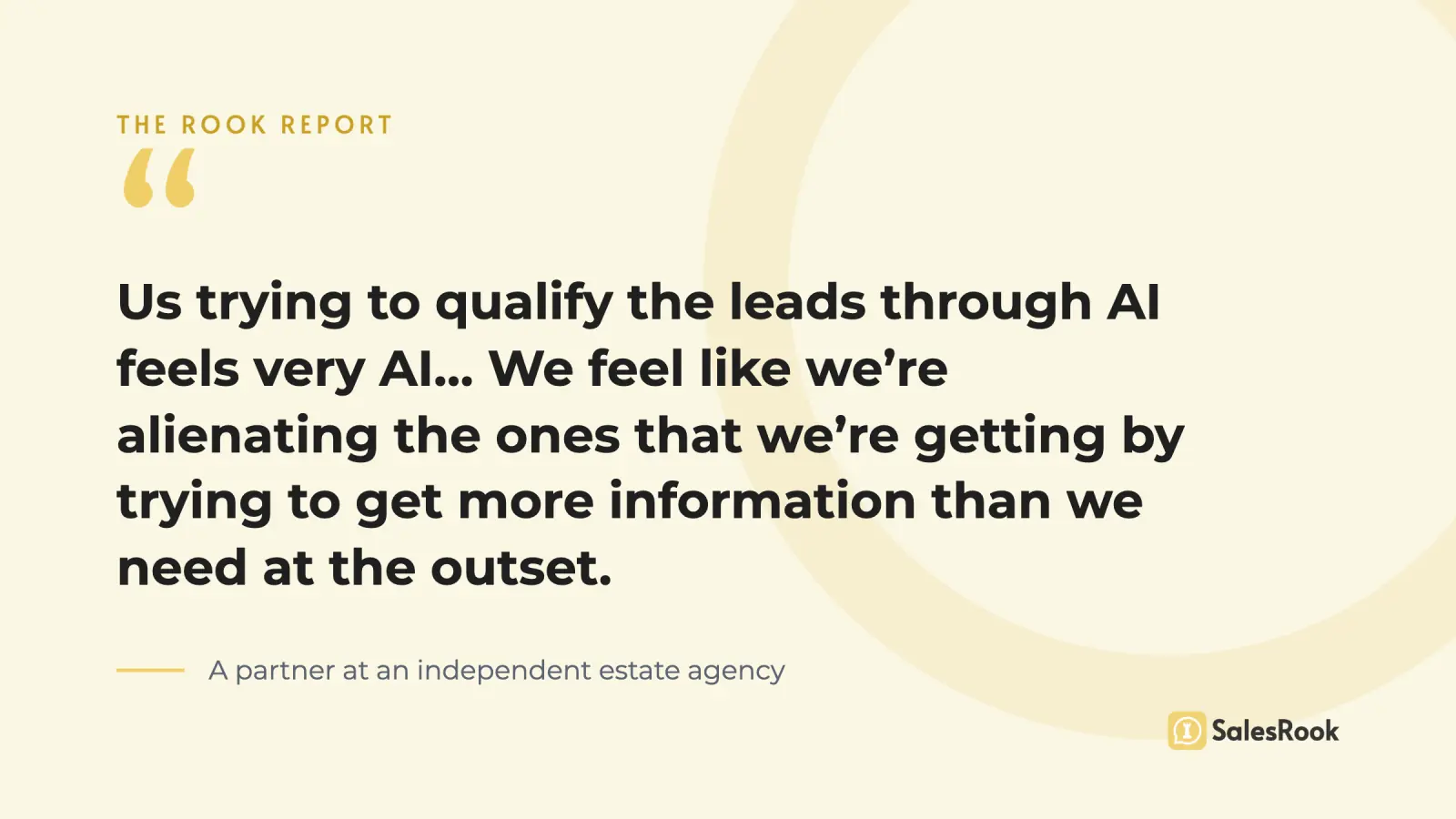
"Us trying to qualify the leads through AI feels very AI… We feel like we're alienating the ones that we're getting by trying to get more information than we need at the outset."
That sentence is the single biggest objection to AI in our industry, and it has almost nothing to do with whether the technology works. Nobody in 2026 seriously doubts that an AI chatbot can answer a property enquiry. The fear is subtler and far more personal than that. It is that the AI will answer, and sound like a machine doing it, and quietly repel the very buyers and sellers you paid Rightmove to send you.
If you want the whole picture, we have a full guide to AI for estate agents. This piece is narrower, and a little more uncomfortable. It is about whether the thing sounds human.
I take that fear seriously, because the people who raise it are usually right about their own businesses. So rather than argue with it, I want to do something the debate almost never does.
I want to measure it.
Why "robotic" is the only objection that matters
Estate agency is a relationship business that happens to move houses. Ask agents to describe themselves and you hear the same thing over and over. One director told me plainly, "we're still a company of, get on the phone." Another, weighing up whether to switch us on at all, said the thing that should stop any proptech founder in their tracks:
"SalesRook is going to be, to a lot of people, people's first impression of our company."
A director at a rural independent agency
That is why "it sounds robotic" is not a feature quibble. It is a brand risk. The AI is standing on the doorstep in your name, and if it feels like a machine, the damage is not a slow reply, it is a bad first impression of a business built on good ones.

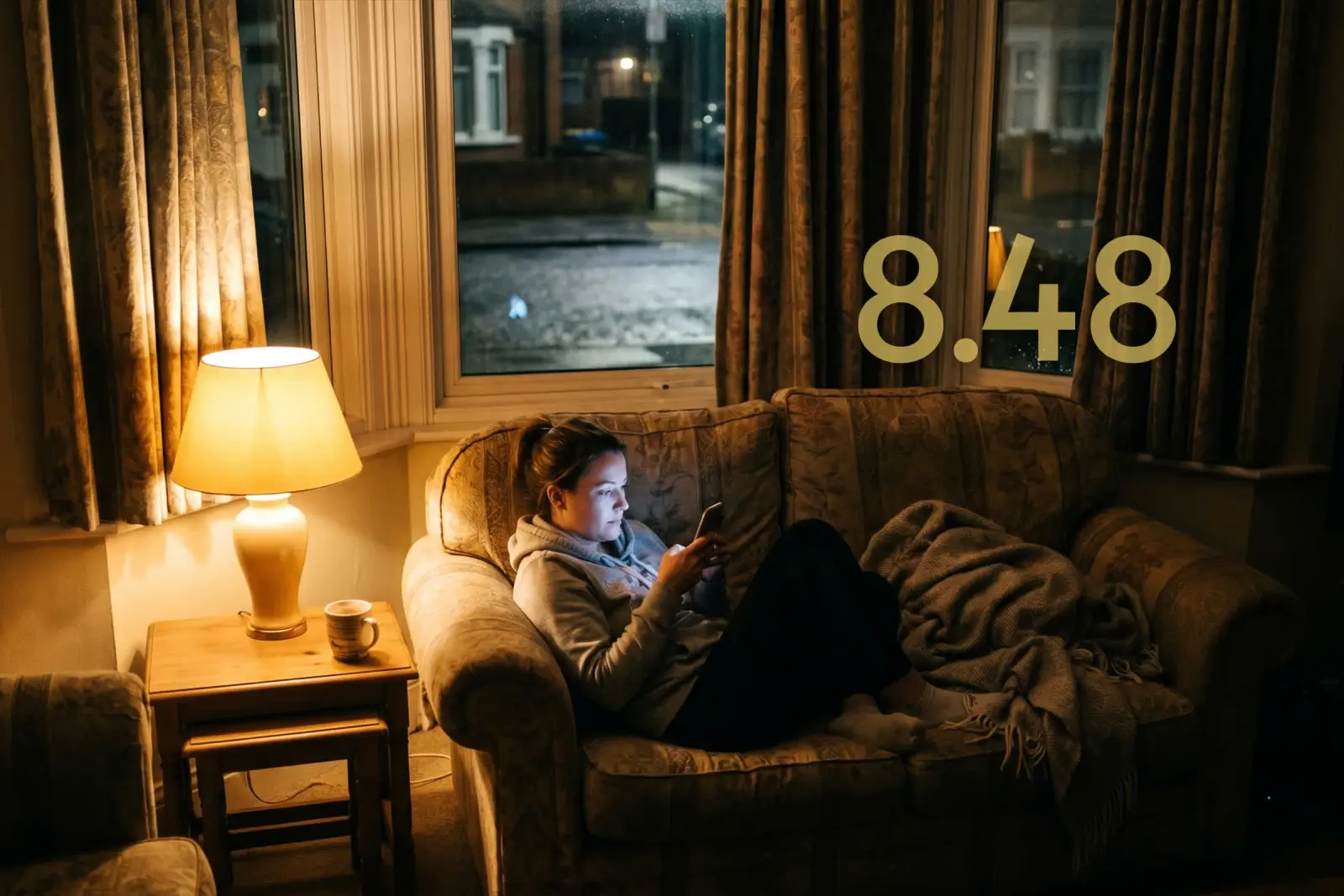
The person on the other end of the enquiry. Get the tone wrong and this is who quietly drifts away.
And the bar keeps rising. Street Group's survey of 1,830 sellers found 85% now expect a reply within 24 hours. So the AI is not only making a first impression, it is making the fast first impression the whole market now demands. Get the tone wrong at speed and you have simply found a more efficient way to make a bad one.
The industry's own leadership lands in the same place. Propertymark chief executive Nathan Emerson has put it plainly: buying or selling a home is still an incredibly personal process. The consensus view, as ARLA Propertymark framed it earlier this year, is that the agencies that thrive will be those using AI to enhance their service, not replace the human element. Kim Lidbury, ARLA Propertymark's current president, leads a body whose whole message to members is that the relationship is the product. Even the hard employment data says the same thing: as agencies lean on AI for admin and headcount softens, industry leaders are clear the human element stays essential for the higher-value work. The machine is meant to take the typing, not the trust.
And agents are moving anyway. Cautiously. Alto's 2026 Agency Trends Report found that 52% of agents plan to adopt AI tools within the year, yet around a third describe themselves as nervous or unsure, and that hesitation is heaviest among exactly the independent, relationship-led firms where the "feels like AI" pain is sharpest. The question in the market was never does it work. It was always will it embarrass me.
It is a fair question, and the industry has been arguing it out in public. This Kyero panel of proptech and agency voices is a good, honest version of the debate, worth twenty minutes before we get to the numbers.
Kyero Pro Podcast: the human-touch debate the whole industry is having. We wanted to answer it with data.
What actually makes an AI sound like a robot
Here is the part most vendors skip. "Robotic" is not a mysterious quality. It is a set of specific, fixable tells, and agents can name every one of them. The one that comes up more than any other is a single line of compliance furniture: "Reply STOP to opt out." Agents object to it because it announces the automation before the message has said anything useful. It is also, on the WhatsApp Business API, largely unavoidable, which is precisely why every other line in the message has to work harder.
The tells are almost never the sentences a human would write. They are the scaffolding around them:
- The compliance furniture. "Reply STOP to opt out." "This is an automated message." The legal boilerplate that no negotiator has ever typed.
- The interrogation. Firing sensitive qualifying questions, budget, position, mortgage, in the first breath, before any human would dream of asking.
- The rigid script. Answers that ignore what the person just said and march to the next step in a workflow, because there is a workflow.
- The uncanny speed with no warmth. A reply in two seconds that reads like a form letter is worse than a slower one that reads like a person.
None of these are AI problems. They are configuration problems. That distinction matters because it turns "AI sounds robotic" from a reason to do nothing into a checklist you can work through. It also reframes the whole question of whether an AI chatbot for estate agents is worth the risk: the answer was never the technology, it is the control you keep over it.
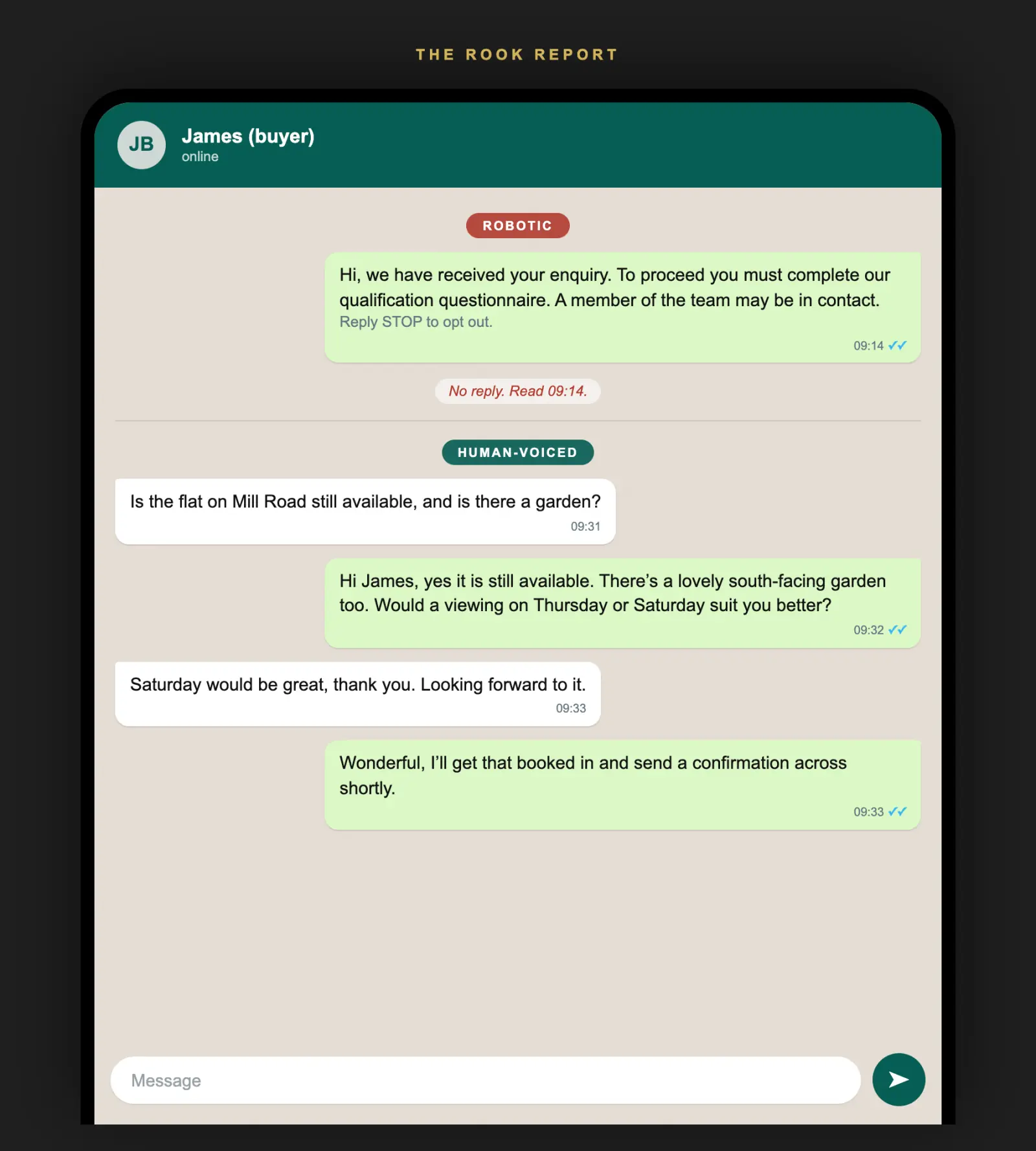
Same enquiry, same job to do. One gets read and ignored. One books the viewing.
Put the two side by side and you do not need a focus group. The difference is obvious in a second. One reads like a form. One reads like a person who happens to be very fast.
So we measured ours
Talking about tone is cheap. Every vendor's demo sounds human for four messages. We wanted a number. So we run automated sentiment analysis across the conversations our AI has, scoring each one on how the person on the other end actually responded.
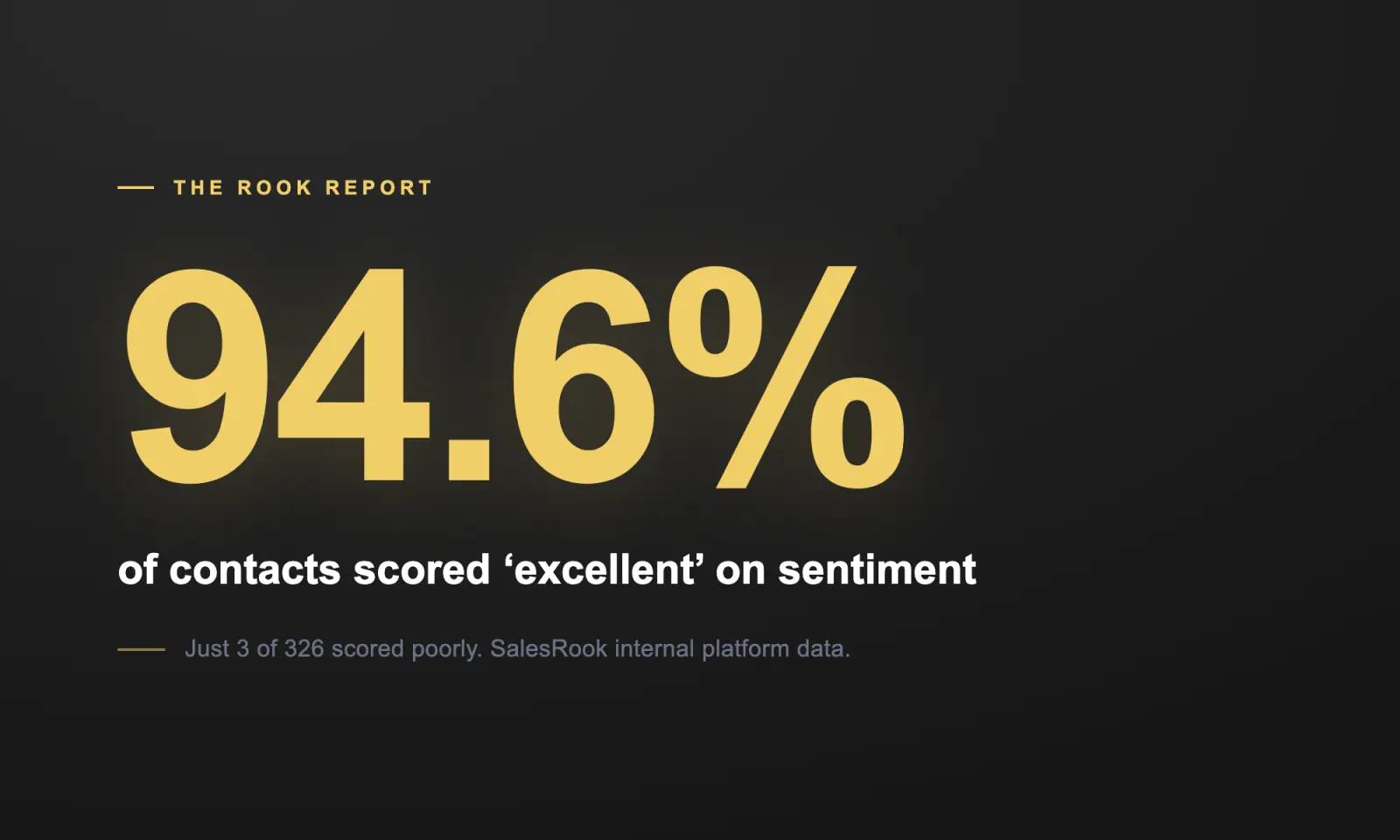
In one recent month, for a single mid-sized agency, 94.6% of contacts scored "excellent" on sentiment. Out of 326 conversations, just three scored poorly. That is our own platform data, not an audited third-party figure, and I will always label it as such. But it is a real measurement of real conversations, and it is the opposite of what "robotic" predicts.
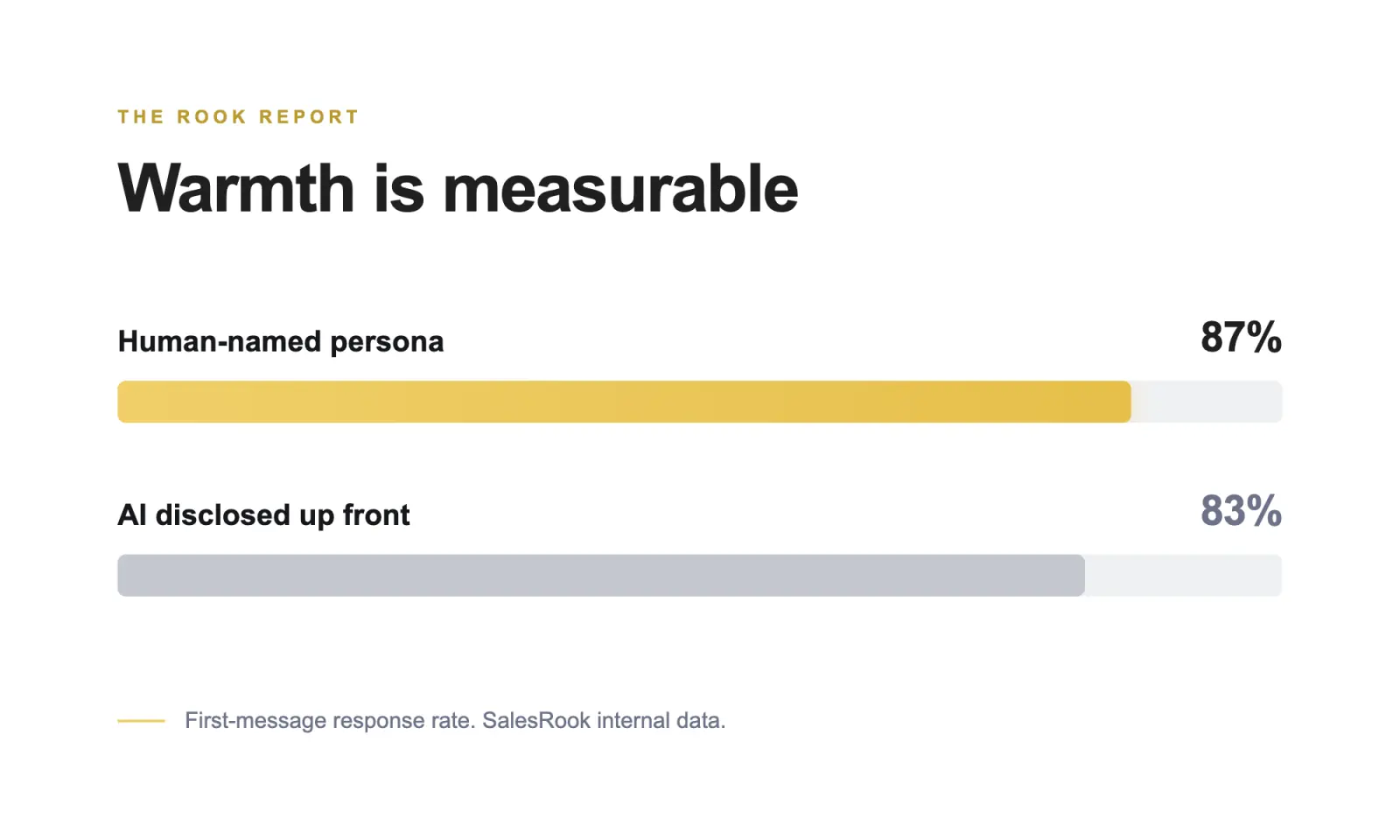
Then there is the finding I find most revealing, because it puts a price on personality. We can run the same AI with a human name and a warm, first-person voice, or with an up-front "I am an AI assistant" disclosure. The human-named, human-voiced version earns roughly a 4% higher first-message response rate. Same engine. Same questions. The only variable is whether it feels like a person. Warmth is not decoration. It is measurable conversion. Four points does not sound like much until you price it against every enquiry you already pay the portals to send you, which is the whole hidden economics of estate agent lead generation.
Which raises the honest question underneath all of this: can people even tell? The best evidence we have is humbling for everyone. A widely cited 2024 Bynder study of 2,000 UK and US consumers found only 45% of Britons could reliably distinguish AI-written copy from a human's, and, tellingly, people rated the AI version more engaging until they were told what it was, at which point engagement fell. People do not dislike AI writing. They dislike being made to feel they are talking to a machine. Those are different problems, and only one of them is about quality.
The uncomfortable part: honesty costs you, and you pay it anyway
If a warm, human-named persona converts better, the cynical move is obvious: hide the AI entirely. We do not, and I want to explain why, because it goes to the heart of doing this properly.
Our AI will tell someone it is an AI if they ask it directly. That transparency measurably costs us a few points of conversion, every month, on purpose. We think it is the right call anyway, and not only for the obvious ethical reasons. Trust in AI is genuinely fragile right now. Pew Research found just 16% of Americans think AI's impact on society will be positive, and a Quinnipiac poll put trust in AI-generated information at 21%. Those are US figures, but the mood travels. In a low-trust environment, getting caught pretending is far more expensive than the few points you save by pretending well. The goal is not to fool anyone. It is to be good enough that it does not matter.
The mechanism, for the curious, is un-robotic by design. Rather than firing pre-written templates down a decision tree, the system writes every single message from scratch, in context, so the conversation reads like a person thinking, not a workflow executing. That is the whole reason the sentiment numbers look the way they do.
The near-miss that proves the point
The most persuasive story I have is not a triumph. It is a firm that almost fired us. An independent agency had switched the AI on, and one of its negotiators wanted it gone. Her words:
"To be honest, I was the one pushing us to get it turned off. Only because my opinion, in terms of contacts and enquiries, it just takes away that personable initial contact."
A negotiator at an independent estate agency
She was not being a Luddite. She was defending the thing that made her agency good. And she made an argument I completely accept:
"I think it's a good product if you're not in the office able to get through your leads. But if you've got enough manpower and you're sitting here and you can call your leads, I think it's just better that it's coming from a real person who can have that conversation, is knowledgeable on the property and can … create the urgency and book the viewing in straight away."
She is right. So we did not argue with her. We changed the configuration. We moved them to a human-plus-AI hybrid: during office hours, when a negotiator is free, the human takes the lead; out of hours, at the weekend, and during the overflow that breaks every busy branch, the AI is the always-on safety net that means no enquiry ever sits unanswered until Monday. The answer to "it feels robotic" was never to switch the AI off. It was to give the agent control over when it speaks.
That is the reframe the whole debate needs. Robotic is not a property of AI. It is a property of AI you cannot control.
What it looks like when it works
When the tone is right and the control is right, the fear inverts. Instead of repelling people, the conversation converts them. One London lettings owner sent a single warm, conversational message to a list of landlords about their valuations. He got a 50% response rate, won four valuations off the back of it, and every one of them instructed him. That is not a broadcast blast that people mute. That is a message that felt worth replying to.
A 16-branch London agency went further. Their AI persona became their number two source of instructions, ahead of Rightmove, Zoopla and OnTheMarket, and they subsequently dropped one of their paid portals. An enquiry channel that agents feared would alienate buyers turned into a lead source that outperformed portals they had been paying for years. When an AI persona out-earns Rightmove, it has stopped being a cost saving and become a channel. The mechanics of that channel are the whole subject of our guide to WhatsApp for estate agents.
And the reactions, when the scepticism breaks, are not lukewarm. One branch principal, watching it work, said, "I like this system, because there's a lot of tech behind it… it's very professional… I'll have to leave you a Google review." Nobody talks about a robot that way.
None of this is unique to insurgent proptech, either. Rightmove has built its own beta AI conversational search with Google Cloud. The portals themselves are putting AI at the front of the property conversation. The question for an agent is no longer whether AI belongs in the enquiry flow. It is whether the AI carrying your name sounds like you. And the human is not going anywhere: even in the US, where buyers lean hardest on AI to research a purchase, 81% still say a human agent is essential to the deal. The technology changes who does the typing, not who closes the sale.
How to make sure yours does not sound robotic
I would rather teach you to get this right, with any tool, than sell you a mystery. If you are putting AI anywhere near your enquiries, here is the checklist we would apply, and you can hold any vendor to it:
- Kill the tells. No "STOP to opt out" in the message body. No "I am an automated assistant" opener. Handle compliance without wearing it on your sleeve.
- Give it a name and a voice. A warm, first-person persona that sounds like a real member of your team, because the data says it converts and the buyer says it matters.
- Be honest when asked. Transparency on request is cheap insurance in a low-trust moment. Never build your model on getting away with it.
- Earn the right to qualify. Warm the conversation before you ask the sensitive questions. A human would. So should the AI.
- Demand control, not just automation. Insist on a hybrid mode where your people can take over instantly. The firms that keep AI are the ones that decide when it speaks.
- Point it at the gap, not the relationship. The highest-return use is the after-hours enquiry, the weekend flood, the lead that would otherwise wait until Monday, exactly the moments a human cannot cover. Let it protect the relationship, not perform it.
The partner I opened with was not wrong to worry. An AI that sounds robotic really will alienate the buyers you worked to win. But "robotic" is a choice made in configuration, not a law of nature.
We measured ours because the only honest answer to a fear is evidence. And the evidence says a trained, controlled, human-voiced AI does not push people away.
It answers the enquiries your team cannot reach, in a voice that sounds like the business above the door, and it hands you back the hours to do the part no machine should: pick up the phone, look someone in the eye, and sell the house. Leaving the phone to your people is not an accident of how we built this; it is the design.
I said the only honest answer to a fear is evidence, so here is the offer: give us a week of your enquiries and we will show you what they sound like handled this way, in your voice, on your own numbers. No pitch. Just your data.
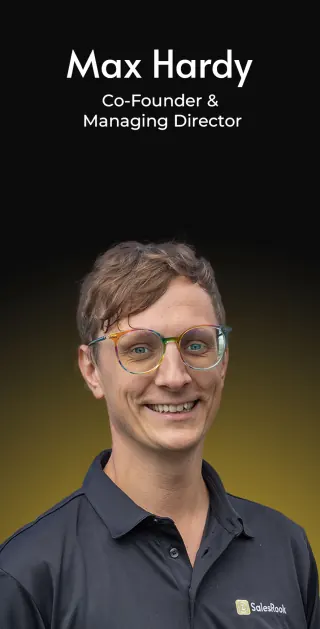
Max Hardy
Co-Founder
Max Hardy is the Co-Founder of SalesRook, a leading provider of AI solutions for the property sector. With a background in technology and property, Max leads SalesRook's mission to transform how estate agents and mortgage brokers engage with leads through AI-powered WhatsApp automation.