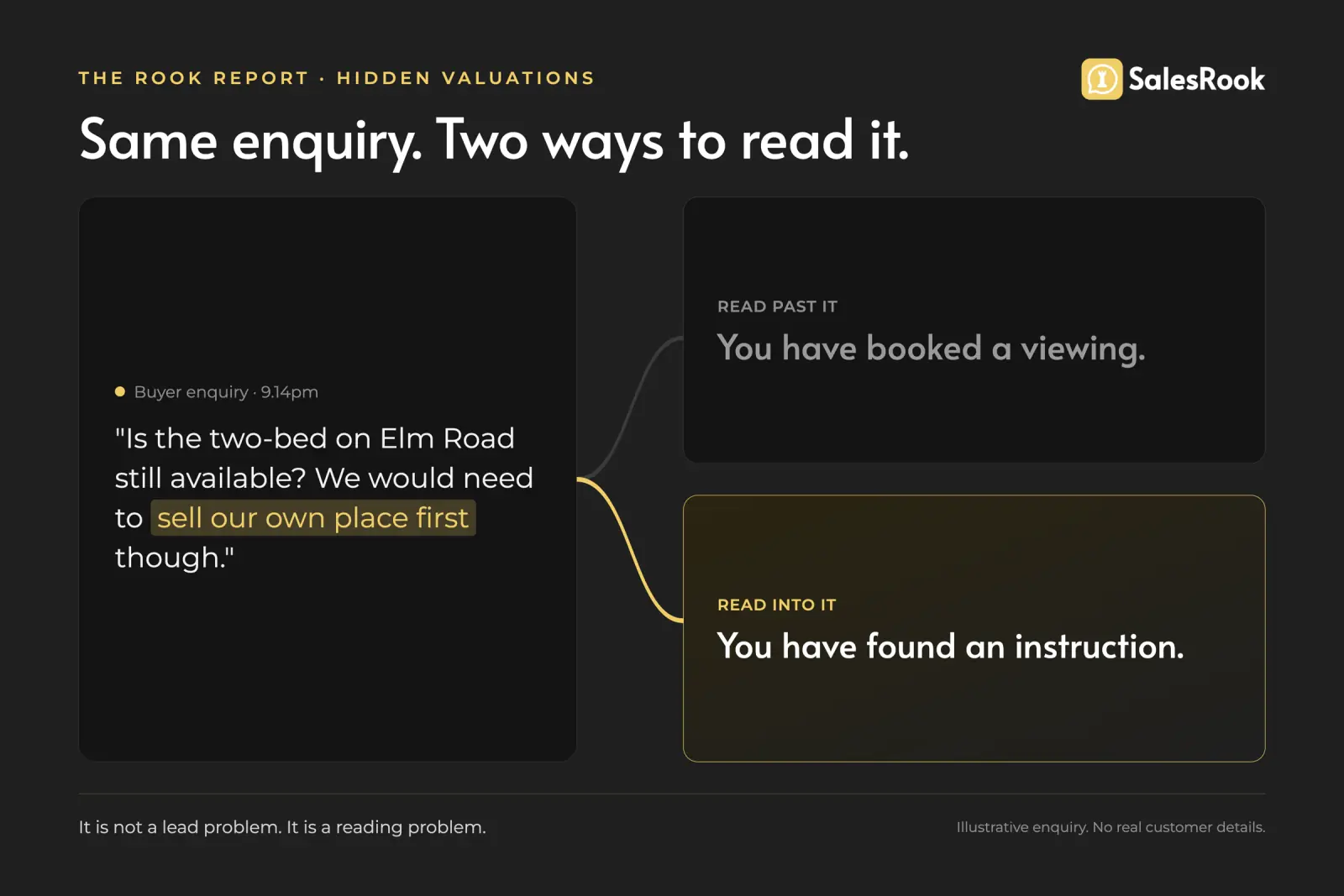
Here is a number that should bother you more than it does. I suspect that by the end of this article it will. In our own data, roughly one in five buyer enquiries is hiding a valuation: a seller with a property of their own to move, sitting quietly inside a message you filed as a viewing request and never thought about again.
I run SalesRook, and I spend most of my week with agency directors who are certain they have a lead problem. They almost never do. What they have is a reading problem. The enquiries already arrive, they have already paid for them, and the second opportunity buried inside each one walks out of the conversation unspotted, taking its fee with it. That gap, between the enquiry you answer and the one hiding underneath it, is where estate agent lead generation is quietly won or lost.

The seller you have not met yet
Think about who actually sends an enquiry about a two-bed flat. A few are first-time buyers with nothing to sell. But a large share are already on the ladder, and the only way they buy is by selling first. Barclays found that roughly a third of recent buyers and sellers were part of a property chain, moving one home as they bought another. A good share of those are a valuation you could be doing, if only you knew to ask.

This is what a hidden valuation looks like before anyone spots it: someone at home, asking about your listing, not yet thinking of herself as a seller. She will only mention her own place if the reply invites it.
The trouble is that nobody announces it. A vendor does not open with "I would like you to value my house." They ask about your listing, because that is the door that happens to be in front of them, and somewhere in the third sentence they let slip that they will need to sell their own place first. Read past that line and you have booked a viewing. Read into it and you have found an instruction. It is the same enquiry either way. The only variable is whether anyone was paying attention.
They come in every disguise. The downsizer asking about a bungalow has a family house to move. The couple enquiring about somewhere bigger two streets over are sitting on a flat that has to go first. The person asking oddly specific questions about a road they clearly already live near may well be testing what you know before they trust you with their own instruction. None of them will say the word valuation. Any of them could be one.
The people who run agencies know this. The same senior leader, talking about his own network, put the scale of it as an estimate rather than a count:
"And I think three-quarters of the people that register, if they have something to sell, it will be in our network. So if we don't police and manage that properly, we'll miss the opportunity."
A senior leader at a multi-branch London agency
He says "I think", and he means it as a guess about his own patch rather than a measured figure, which is exactly how I would ask you to read it. Take it as an estimate and it is still a striking one: the sellers are already in the building. Whether they are ever recognised comes down to the word he chose, police, and to whether anyone is doing it.
The margin argument could hardly be cleaner: no new lead spend, no fresh campaign, just a second and larger opportunity lifted out of an enquiry already sitting in your hand.
Why the valuation never gets asked for
Because a busy branch cannot read every enquiry closely enough, quickly enough, to catch the tell. The volume is against you, the clock is against you, and the tell is subtle by design. The agencies that look hardest at this already know how brutal the drop-off is. One senior leader at a multi-branch London agency, midway through an audit of what his portal spend was actually buying him, put the scarcity plainly:
"We're assessing the quality from the portals because we get high numbers from some, but very few become either valuations, let alone instructions or sales."
A senior leader at a multi-branch London agency
That is the economics of the thing in a single sentence. High numbers in, very few valuations out. Every one of those enquiries cost the same to buy, and only a small fraction will ever turn into someone asking you to value their home, which is exactly why the ones hiding in plain sight are so expensive to walk past. An agency that finally reads its enquiries properly is not buying more of them. It is collecting on the ones it has already paid for.
He also had a plainer explanation for where the valuations go, and it is not a lack of effort. It is a question of whose job it looks like:
"I mean, the sales staff will always concentrate on the lead part of the enquiry, what they want to view. The management team tend to pick up the valuation opportunity more, focus on that more."
A senior leader at a multi-branch London agency
That is an admission about his own sales floor, and it is worth more than any diagnosis I could offer from outside. The negotiator answers the question in front of them, because the question in front of them is a viewing. The valuation hiding in the same message belongs, in everyone's head, to somebody more senior.
So it waits for a person who was never copied in.
High numbers in, very few valuations out
The drop-off from enquiry to valuation is savage, and it is the reason a missed one hurts so much. Volume beats a tired human reader every single time. It does not beat a system built to read every message the moment it lands, and to read the hundredth as closely as the first.
Speed makes the reading possible, because a person only opens up while their attention is still on you, and that window is short. In a July 2026 Street Group survey of 1,830 sellers, 85% said they expect a reply within 24 hours. Yet a great many enquiries land in the evening and at the weekend, long after the branch has emptied, which is a leak in its own right and one I have written about in the enquiries that arrive after hours. A valuation that surfaces at 9pm on a Saturday and waits until Monday to be read may already be sitting in a rival's diary by Monday.
What a well-read first reply actually does
The fix is not a cleverer marketing funnel. It is answering every enquiry instantly, on a channel people actually read, and having the first reply do the reading a stretched team cannot. When an enquiry lands, our AI replies within seconds, on WhatsApp, in your agency's name, and holds a proper qualifying conversation: what are they after, what is their timeline, and, said as naturally as a good negotiator would, do they have a place of their own to sell. Across our own conversations, not any one client's, WhatsApp reply rates run close to 87%, against roughly one in five for email. That is the difference between a question that gets answered and one that gets ignored.
There is a timing dividend on top. In our own platform data, around half of all enquiries arrive when the branch is shut, in the evenings and at weekends, which is often when a seller, finally home from work and thinking about their move, lets it slip. A warm, well-read reply at 9pm catches that admission while the person is still leaning into the conversation. A voicemail returned on Tuesday does not.
When the seller signal appears, it is caught and flagged rather than skimmed past, and the negotiator opens their morning to a summary that already tells them where the money is, instead of a cold list of names to chase. And because every word of it is logged and timestamped rather than living in someone's head or on a personal phone, the valuation you surfaced tonight is easier to hand over and far harder to lose when that negotiator eventually moves on.
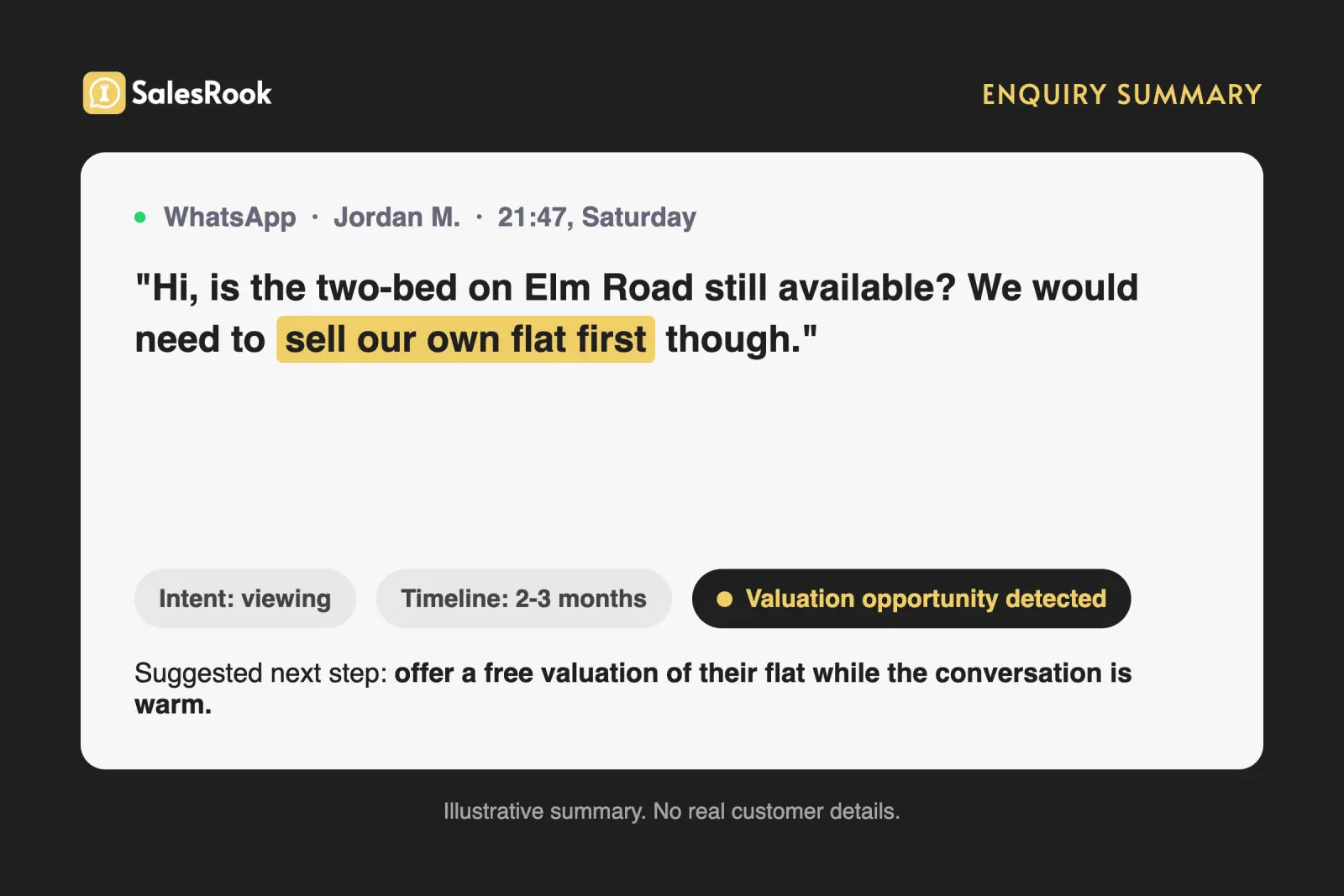
The valuation hides in plain sight. Reading the enquiry, not just replying to it, is what turns a viewing request into an instruction.
None of this is about replacing the human. The valuation appointment, the viewing, the negotiation: that is where your people earn their keep, and it is exactly where you want their hours going. The point of answering the overflow and the after-hours automatically is to make sure the valuation gets booked at all, rather than dying with a "sorry, I forgot to ask." And to be straight about it, none of this manufactures demand that was never there. It will not fix thin stock, or rescue a team that never follows up. All it does is read the enquiries you already get, in time, which is a management choice long before it is a software purchase.
What it was worth to one agency
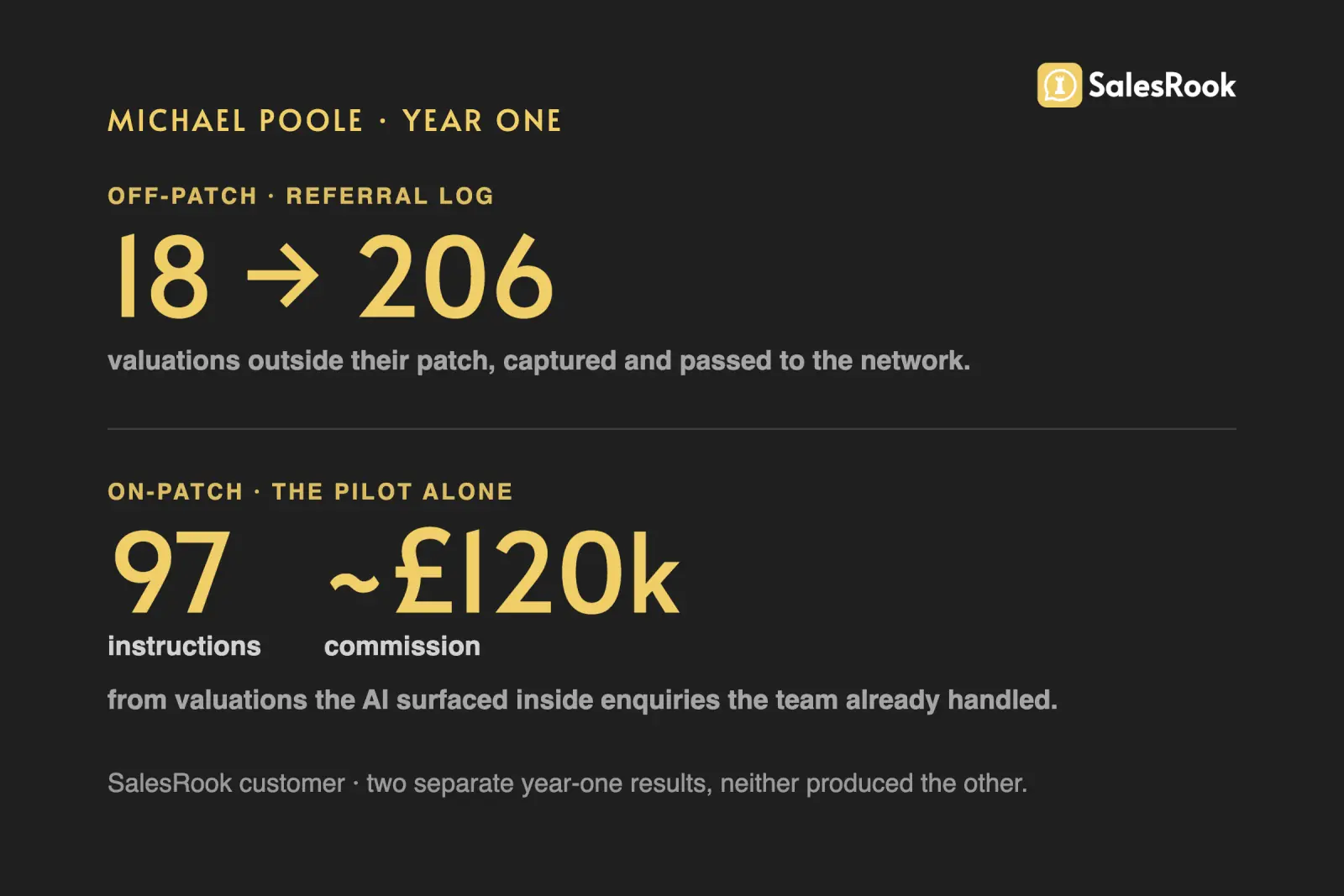
I am wary of numbers with no name attached, so here is one with both. Michael Poole are a family-run agency on Teesside, and we spent a year counting exactly this against their own CRM. Inside the enquiries they were already receiving, roughly one in five turned out to be a valuation opportunity, and reading those properly surfaced 97 instructions worth around £120,000 in commission in the first year, while handling that volume automatically handed the team back 4,246 hours. Same portals, same bill, same team. What changed was that the enquiries finally got read.
Michael Poole's team gave their AI a name, Elsie, and the sharpest moment of the whole exercise came when we walked Rich Poole, their Managing Director, through the year's source data on a call. The valuations Elsie had been lifting out of buyer enquiries had never arrived as valuation leads, which meant even his own sense of where valuations came from was built only on the visible ones. He looked at the breakdown and asked the question this entire article is about:
"You'd have asked me, I'd have said, well, Rightmove is our largest source of valuation leads because of where it comes in. Is that because Elsie's picking them up before they get to us?"
Richard Poole, Managing Director, Michael Poole
It was. And that is what hidden really means: not hidden from careless people, hidden from everyone, including the man who signs the portal bill. A seller surfaced from inside a buyer enquiry shows up in nobody's valuation column, because she never arrived as one. The count is the only place a hidden valuation becomes visible, and until you run it, your instinct about where your instructions come from is an instinct about the visible ones.
And, separately, a second win ran in the opposite direction. Michael Poole belong to the Relocation Agent Network, where members pass buyers moving out of their area to a trusted local agent elsewhere and earn a share of the fee. Once every enquiry was being read, those out-of-area movers stopped evaporating, and their referral log grew from 18 in the prior year to 206. Keep the two firmly apart in your head: the 97 instructions were their own, won on their own patch, and the 206 referrals went out to other agents entirely. Neither produced the other. They are simply two different things that happen when you stop letting enquiries go unread.
A chart is easy to dress up, so it is worth watching the thing actually work. This is a short walk through how the AI reads an ordinary enquiry and surfaces the valuation inside it, start to finish.
A short demo of the AI reading a buyer enquiry and surfacing the seller hiding inside it.
It is a reading problem, not a lead problem
Step back and the economics are stark. The average agency now pays Rightmove around £1,530 a month to make the phone ring, a figure that has climbed as agents buy higher tiers, and feelings about it run hot enough that a group of agents has filed a claim worth up to £1.5bn, alleging the fees are excessive and unfair. Nothing there is proven, and it may never be. But it tells you how dearly you have already paid for each enquiry before anyone even replies to it. The uncomfortable truth about estate agent valuation leads is that many are never generated at all. In our own data, one in five is already sitting in the enquiry stream, missed one skimmed message at a time.
£1,530 a month
is what the average agency already hands a single portal to generate these enquiries. You have paid for every one at the top of the funnel. Letting the valuation inside it go unread is paying twice and collecting once.
The same leak runs through a lettings book, where a landlord is easy to mistake for a tenant, a pattern I have pulled apart in surfacing landlord leads for letting agents. Sales or lettings, the shape is identical: the valuable party is often standing right there in your inbox, dressed as someone cheaper, and the only thing between you and them is whether the first reply read the message properly. When an agency finally audits this for itself, the reaction is almost never outrage at the team. It is the quieter, more uncomfortable realisation that nothing was ever visibly broken. No enquiry bounced. No system failed.
The seller simply asked about a two-bed, got a polite answer about the two-bed, and went to value their house somewhere else.
Do the sum on your own enquiry flow
Let me leave you with the arithmetic rather than a slogan, because you can check arithmetic. Take a single branch handling two hundred enquiries a month. One in five hiding a valuation is forty conversations a month in which the person messaging you also has a home to sell. You will not win all forty. You will not win most of them. But put your own average instruction fee on the handful you do convert, month after month, and set that against the portal package that delivered the enquiries in the first place. The figure gets serious quickly.
And it was sitting in your inbox the whole time, wearing a viewing request.
If you would rather see the real figure than a worked example, we will sit with a month of your own enquiries and mark every valuation that went unasked. No portal upsell, no new leads to buy, just the ones you have already paid for, read properly this time. The count will either put your mind at rest or put a number on the leak. Either way, you stop guessing.

Max Hardy
Co-Founder
Max Hardy is the Co-Founder of SalesRook, a leading provider of AI solutions for the property sector. With a background in technology and property, Max leads SalesRook's mission to transform how estate agents and mortgage brokers engage with leads through AI-powered WhatsApp automation.